
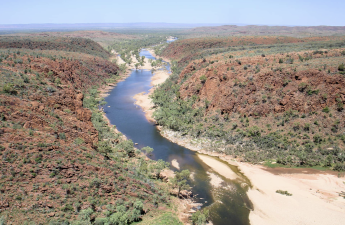
The Finke River, also known to the Arrernte people as Larapinta, is regarded as the oldest surviving river system on Earth. It flows through central Australia across the Northern Territory and South Australia. Scientists estimate that it began forming around 300 to 400 million years ago, making it older than the dinosaurs and among the most ancient active landforms on the planet.
Geographical Significance
The river stretches for more than 640 kilometres through a dry and rugged landscape. Unlike perennial rivers, it flows continuously only after heavy rain. For much of the year, it appears as a series of waterholes and disconnected channels. Despite this, it is considered the same river system that has existed since deep geological time.
Why the River Is Considered Ancient
The Finke River cuts directly through the MacDonnell Ranges, a line of hard rock mountains in central Australia. Rivers usually bend around such barriers. The Finke does not. This unusual path supports the theory of antecedence, which means the river existed before the mountains rose. As the land was uplifted during the Alice Springs Orogeny, the river continued to erode downward and preserved its course.
Scientific Evidence
Researchers have studied the surrounding rocks, sediments and erosion patterns to estimate the river’s age. Chemical changes in the landscape and radioactive isotope dating suggest that the river system is at least as old as the mountain-building event. This makes it one of the clearest examples of a river maintaining its original course over hundreds of millions of years.
Exam Relevance
The Finke River is important for geography, geomorphology and physical evolution of landscapes. It illustrates antecedent drainage, tectonic uplift and long-term river stability. It is also a useful example of how ancient river systems can survive in arid environments with limited but persistent flow.
Last Modified: April 27, 2026