
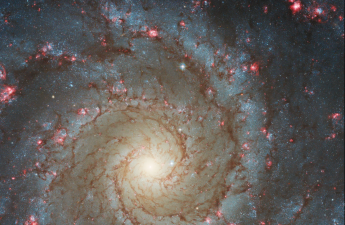
Between 2025 and 2026, NASA’s Hubble Space Telescope released a series of high-resolution images targeting several nearby spiral galaxies. These observations form part of a coordinated effort to investigate the mechanisms governing star formation, stellar evolution, and structural dynamics within galactic systems. By capturing distinct spectral signatures across multiple wavelengths, the telescope provided data on the interstellar medium, stellar nurseries, and cosmic phenomena. The targeted galaxies include NGC 3137, Messier 83, IC 486, NGC 7496, and Messier 96, each presenting unique structural characteristics that contribute to the broader understanding of the lifecycle of stars and the evolution of galaxies.
Key Galaxies Observed and Structural Characteristics
NGC 3137 (Antlia Constellation)
Located approximately 53 million light-years from Earth, NGC 3137 is an unbarred spiral galaxy with loosely wound arms, classified morphologically as SA(s)d. It is highly inclined from the terrestrial perspective, offering a clear view of its feathery structure. The galaxy is a prominent member of the NGC 3175 galaxy group, which serves as an analogue to the Local Group containing the Milky Way and Andromeda. NGC 3137 features a supermassive black hole at its core estimated to be 60 million solar masses.
Messier 83 (Hydra Constellation)
Commonly known as the Southern Pinwheel Galaxy, Messier 83 is a barred spiral galaxy situated roughly 15 million light-years away. It is characterized by exceptionally high rates of star formation, particularly within its nuclear region, making it a classic example of a starburst galaxy.
IC 486 (Gemini Constellation)
IC 486 is a barred spiral galaxy positioned at a distance of nearly 380 million light-years. It features a bright central bar from which spiral arms wrap smoothly around the core in an almost ring-like pattern. The galactic center hosts an Active Galactic Nucleus (AGN) driven by a supermassive black hole exceeding 100 million solar masses.
NGC 7496 (Grus Constellation)
NGC 7496 is a barred spiral galaxy that holds distinction as the first galaxy of its type studied by the James Webb Space Telescope (JWST) under the PHANGS programme. The galaxy features prominent dust lanes and intense star-forming regions along its central bar and spiral arms.
Messier 96 (Leo Constellation)
Messier 96 is an asymmetric intermediate spiral galaxy located about 35 million light-years away in the M96 Group. Its distinct asymmetry is primarily caused by gravitational interactions with neighboring galaxies, which have disrupted its gas distribution and influenced its star formation patterns.
Mechanics of Galactic Star Formation
The Interstellar Medium and Molecular Clouds
Star formation occurs within dense, cold regions of the interstellar medium known as giant molecular clouds. These reservoirs are composed mostly of molecular hydrogen (H2) and cosmic dust. When external forces, such as gravity or shockwaves, cause these clouds to collapse, the core temperature and density rise, leading to the creation of protostars.
Spectral Tracers in Spiral Arms
Spiral arms act as density waves that compress gas and dust, triggering star birth. Observational telescopes utilize color filters to map the different evolutionary stages of these regions:
| Color/Feature | Physical Component | Significance in Stellar Evolution |
| Bright Blue Regions | Massive, hot young stars (O and B-type) | Indicates recent star clusters that have cleared their birth cocoons. |
| Glowing Red Clouds | Ionized Hydrogen (H II regions) | Shows active stellar nurseries where stars are still encased in natal gas. |
| Dark Dust Lanes | Dense molecular gas and interstellar dust | Highlights the raw materials reserved for future generations of stars. |
The PHANGS Observational Programme
Multi-Scale, Multi-Phase Astronomy
The Physics at High Angular Resolution in Nearby GalaxieS (PHANGS) programme is an international collaboration tracking the lifecycle of star-forming regions across nearby spiral galaxies. It integrates data from major observatories to map different components of the galactic structure.
Observational Synergy
- Hubble Space Telescope (HST): Captures high-resolution ultraviolet and optical data to identify young stellar clusters and measure stellar ages.
- James Webb Space Telescope (JWST): Utilizes infrared instruments to pierce through thick dust lanes, revealing embedded protostars and glowing dust grains.
- Atacama Large Millimeter/submillimeter Array (ALMA): Maps cold carbon monoxide (CO) gas, tracing the distribution of molecular clouds before star formation begins.
- Very Large Telescope (VLT-MUSE): Provides optical spectroscopic mapping to track ionized gas and galactic kinematics.
IASPOINT Booster Facts for UPSC
- Morphological Classification: The Hubble sequence classifies galaxies based on visual appearance into elliptical, spiral, barred spiral, and irregular types.
- H II Region: A region of interstellar atomic hydrogen that is ionized by the ultraviolet radiation from nearby hot, young stars.
- Active Galactic Nucleus (AGN): A compact region at the center of a galaxy that emits abnormally high luminosity across the electromagnetic spectrum, powered by mass accretion onto a supermassive black hole.
- The Local Group: The galaxy group that includes the Milky Way, Andromeda, Triangulum, and over 50 dwarf galaxies, bound together by gravity.
- NASA/ESA Collaboration: The Hubble Space Telescope is a project of international cooperation between NASA and the European Space Agency (ESA).