
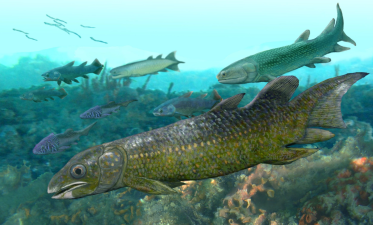
Researchers at Flinders University utilized advanced imaging techniques to analyze the 380-million-year-old fossil fish Koharalepis jarviki discovered in Antarctica. The study of its remarkably preserved braincase revealed new details about sensory adaptations to shallow water environments prior to the colonization of land by vertebrates. This anatomical discovery clarifies how early aquatic creatures modified their olfactory, visual, and respiratory systems during the Devonian period. The finding connects with other recent global fossil discoveries to map the complex skull modifications that enabled the historic transition of vertebrates from water to land.
Cranial Anatomy of Koharalepis jarviki
The fossilized braincase of Koharalepis jarviki offers a physical record of the internal cranial architecture of Devonian lobe-finned fishes.
Sensory and Respiratory Configurations
High-resolution micro-computed tomography (μCT) scanning of the Koharalepis jarviki braincase exposed the internal pathways of cranial nerves and blood vessels. The structural layout shows a transitional phase in vertebrate evolution:
- Olfactory Enhancements: Enlarged nasal cavities indicate a reliance on chemical sensing in murky, shallow-water habitats.
- Visual Adaptations: The positioning of the optic nerve canals suggests a field of vision optimized for surface hunting or navigating shallow profiles.
- Respiratory Pathways: The internal gill-arch supports and spiracular openings document the mechanical transition toward air-breathing capabilities.
Shallow Water Adaptations
The physical traits of Koharalepis jarviki show specific adaptations for survival in low-oxygen littoral zones. Its skeletal structure supported propping its body up in shallow estuaries, a behavioral trait that preceded the development of actual limbs in early tetrapods.
Global Discoveries in Vertebrate Skull Evolution
The analysis of Koharalepis jarviki is part of a series of global fossil discoveries that clarify the structural evolution of the early vertebrate skull.
| Fossil Species / Type | Approximate Age | Discovery Location | Key Evolutionary Insight |
| Koharalepis jarviki | 380 Million Years | Antarctica | Reveals transitional sensory and breathing structures in lobe-finned fish prior to land colonization. |
| Primitive Lungfish Skull | 410 Million Years | China | Delivers the earliest structural evidence of the specialized crushing tooth plates unique to lungfishes. |
| New Coelacanth Species | Devonian Period | London (Museum Archive) | Challenges previous timelines regarding the anatomical diversification and stability of actinistian fishes. |
| Sacabambaspis (Jawless Fish) | 455 Million Years | Colorado, USA | Offers a clear look at primitive defensive armor plates and the early structure of the vertebrate braincase before jaws evolved. |
Sensory Shifts in Paleozoic Lungfish
Comparative studies of Paleozoic lungfish species indicate a distinct sensory trade-off that occurred as vertebrates moved closer to the water-land boundary.
Olfaction Dominance Over Vision
Biomechanical models of early lungfish skulls show that the evolutionary focus favored the sense of smell over sight. As these species adapted to vegetated, muddy channels, their optic lobes shrank relative to their expanding olfactory bulbs. This change allowed them to detect prey and predators through chemical signals when poor water clarity made vision ineffective.
Link to Early Tetrapod Development
This sensory shift directly influenced the neurological blueprint of the first tetrapods. When the descendants of lobe-finned fishes moved onto land, they brought highly developed olfactory systems well-suited for smelling in the air. Their vision systems then adapted over millions of years to accommodate the different refractive properties of air compared to water.
IASPOINT Booster Facts for UPSC
- The Devonian Period: Known as the “Age of Fishes,” the Devonian period spanned from about 419 to 359 million years ago. It saw a massive diversification of marine life and the appearance of the first tetrapods.
- Lobe-Finned vs. Ray-Finned Fishes: Sarcopterygii (lobe-finned fishes) possess fleshy, lobed paired fins joined to the body by a single bone, making them the direct ancestors of all land vertebrates. Actinopterygii (ray-finned fishes) have fins supported by webs of bony spines and constitute 99% of modern fish species.
- Living Fossils: The Coelacanth (Latimeria) and modern lungfishes are classic examples of living fossils. They retain morphological traits from the Paleozoic era with minimal structural changes over hundreds of millions of years.
- Antarctica’s Geological Past: The discovery of Koharalepis jarviki in Antarctica is possible because the continent was part of the supercontinent Gondwana during the Devonian period. It was located in a lower, warmer latitude and covered in subtropical forests and river systems.
- The Spiracle: In early fossil fishes, the spiracle was an opening behind the eye used to draw oxygenated water into the gill chambers. In modern land vertebrates, this structure has evolved into the Eustachian tube of the middle ear.