
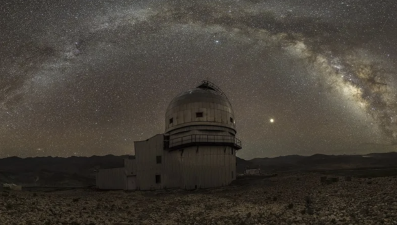
India has approved two major new telescopes in Ladakh and the upgradation of an existing facility, strengthening the country’s observational astronomy network. The projects include a large solar telescope near Pangong Tso, a giant optical-infrared telescope in Hanle, and an upgraded Himalayan Chandra Telescope. The move is expected to deepen India’s role in solar physics, exoplanet studies, and research on the origins of the universe.
National Large Solar Telescope
The National Large Solar Telescope (NLST) will be a 2-metre aperture solar observatory in the Merak region near Pangong Tso lake. It will observe the Sun in visible and near-infrared wavelengths.
- It will study solar dynamics, magnetism, and energetic solar events.
- It will help map space-weather processes that affect Earth and satellites.
- It is expected to become India’s third ground-based solar observatory.
India currently has the Kodaikanal Solar Observatory and the Udaipur Solar Observatory. NLST will complement data from Aditya-L1, India’s first space-based solar observatory.
National Large Optical-Near Infrared Telescope
The National Large Optical–Near Infrared Telescope (NLOT) will be built in Hanle. It will have a 13.7-metre segmented primary mirror made of 90 hexagonal mirror segments.
- It will operate in optical and near-infrared wavelengths.
- It will benefit from Ladakh’s high altitude, dry air, and clear skies.
- It will support research on exoplanets, stellar evolution, galaxies, and supernovae.
The telescope is expected to be among the world’s largest in its category and will help trace clues to the origins of the universe.
Upgradation of Himalayan Chandra Telescope
The 2-metre Himalayan Chandra Telescope (HCT), one of Ladakh’s earliest major observatories, will be upgraded after 25 years of operations. Its new 3.7-metre segmented primary mirror will improve optical-infrared observations.
- HCT has been important for transient astronomy.
- It will complement projects such as LIGO-India and the Square Kilometre Array.
- Its upgrade will expand India’s capacity for time-sensitive cosmic observations.
Strategic Importance of Ladakh
Ladakh has emerged as a key astronomy hub because of its clear skies and low atmospheric interference. Hanle is already India’s first and only Dark Sky Reserve, created to protect natural night darkness. The new telescopes will give Indian scientists access to unique observational windows and strengthen India’s contribution to global astronomy.
Last Modified: April 28, 2026