
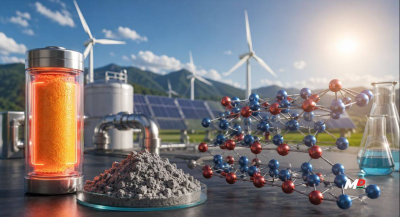
Researchers at the International Advanced Research Centre for Powder Metallurgy and New Materials (ARCI), an autonomous institute under the Department of Science and Technology (DST), have developed a cost-effective and high-performance thermal energy storage material. Utilizing a spinel nanocomposite phase change material (PCM), this innovation substantially improves the efficiency of thermal batteries used in concentrated solar power (CSP) plants and industrial waste heat recovery systems. By adding just 1% of specific nanoparticles, the material increases its specific heat capacity by 45%. This advancement supports India’s clean energy goals and the AatmaNirbhar Bharat initiative by promoting indigenous energy storage technologies.
Understanding Thermal Batteries and Phase Change Materials
The Role of Thermal Energy Storage
Thermal batteries store energy in the form of heat instead of electricity. They capture surplus heat from renewable sources or industrial processes and release it when demand peaks. This bridges the gap between energy generation and consumption, making power grids more stable.
Mechanisms of Phase Change Materials
Phase Change Materials (PCMs) store and release thermal energy during the process of melting and freezing. When a PCM changes from a solid to a liquid state, it absorbs a large amount of heat at a constant temperature. This heat is known as latent heat. Molten salts are widely used as PCMs in high-temperature applications due to their high thermal stability and low cost. However, standard molten salts suffer from low thermal conductivity and limited specific heat capacity.
The Spinel Nanocomposite Innovation
Enhanced Specific Heat Capacity
The ARCI research team introduced spinel nanoparticles into a standard molten salt matrix at a concentration of only 1% by weight. Spinel refers to a class of minerals with a specific cubic crystal structure, typically represented by the chemical formula AB2O4. This minor addition creates a nanocomposite that increases the specific heat capacity of the base material by 45%.
Improved Thermal Conductivity and Stability
Nanoparticles alter the structural properties of the molten salt at the molecular level. This structural modification provides several benefits:
- Higher Thermal Conductivity: The material transfers heat at a faster rate, which speeds up the charging and discharging cycles of the thermal battery.
- Long-Term Thermal Stability: The composite maintains its structural integrity and performance across repeated cycles of melting and solidification.
- Reduced Footprint: Because the material stores more heat per unit volume, engineers can design smaller and more compact thermal storage systems, which lowers overall infrastructure costs.
Applications and Economic Impact
Concentrated Solar Power Integration
Concentrated Solar Power (CSP) plants use mirrors to focus sunlight onto a receiver, heating a fluid to generate steam and drive turbines. The spinel nanocomposite material allows CSP plants to store excess daytime heat more efficiently. This stored heat runs turbines during the night or during cloudy periods, converting intermittent solar energy into a baseline power supply.
Industrial Waste Heat Recovery
Many manufacturing sectors, including steel, cement, and chemical processing, discharge massive amounts of high-temperature waste heat into the atmosphere. Thermal batteries equipped with spinel nanocomposites capture this exhaust heat. Industrial facilities can reuse this energy for internal thermal processes or convert it back into electricity, reducing fuel consumption and lowering carbon emissions.
Core Benefits of the New Nanocomposite Material
| Parameter | Standard Molten Salt PCM | Spinel Nanocomposite PCM |
| Nanoparticle Additive | 0% | 1% by weight |
| Specific Heat Capacity | Baseline | 45% increase |
| System Size | Standard / Large | Compact and smaller footprint |
| Heat Transfer Rate | Slow | Enhanced due to higher conductivity |
| Production Scalability | High | High (developed via scalable methods) |
IASPOINT Booster Facts for UPSC
- ARCI: The International Advanced Research Centre for Powder Metallurgy and New Materials is located in Hyderabad, Telangana. It functions as an autonomous Research and Development centre under the Department of Science and Technology (DST), Government of India.
- Spinel Structure: Spinel is a crystal structure where oxygen atoms form a cubic close-packed lattice. Metal cations occupy specific spaces within this lattice. Examples include Magnetite (Fe3O4) and Gahnite (ZnAl2O4).
- Sensible Heat vs. Latent Heat: Sensible heat storage changes the temperature of a material without changing its phase (e.g., heating water). Latent heat storage absorbs or releases energy during a phase transition at a constant temperature (e.g., ice turning to water).
- National Mission for Enhanced Energy Efficiency (NMEEE): This innovation directly aligns with NMEEE, which is one of the eight missions under India’s National Action Plan on Climate Change (NAPCC).
- AatmaNirbhar Bharat in Energy: India currently imports a large portion of its advanced energy storage components. Developing indigenous thermal battery materials reduces reliance on foreign supply chains for clean energy infrastructure.