
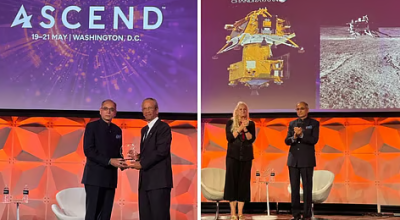
The Indian Space Research Organisation (ISRO) was honored with the prestigious 2026 Goddard Astronautics Award by the American Institute of Aeronautics and Astronautics (AIAA) on May 21, 2026. The award recognizes the historic success of India’s Chandrayaan-3 mission, which achieved a groundbreaking soft landing near the lunar south pole region on August 23, 2023. India’s Ambassador to the United States, Vinay Mohan Kwatra, accepted the award on behalf of ISRO at the AIAA ASCEND 2026 Conference held in Washington, D.C. The recognition highlights India’s expanding capabilities in deep space exploration and its growing bilateral space partnership with the United States.
The Goddard Astronautics Award
Origins and Significance
The Goddard Astronautics Award is the highest honor bestowed by the AIAA for notable achievements in the field of astronautics. The award was originally endowed by Mrs. Esther Goddard to commemorate her husband, Robert H. Goddard, who was a pioneer, engineer, and visionary in liquid-fueled rocket propulsion.
Evolution of the Honor
- Initial Format: The award initially recognized engineering science contributions specifically in propulsion and energy conversion.
- 1975 Restructuring: The institute modified the award name and broadened the selection criteria to encompass holistic, historic milestones in the wider field of astronautics.
- Nomination Rules: The honor can be presented to an individual or a collective team. For team nominations, a maximum of two designated representatives can formally accept the award.
Scientific Milestones of Chandrayaan-3
Target Region Exploration
Chandrayaan-3 made India the fourth nation to achieve a soft landing on the lunar surface and the first to land near the high-latitude southern polar region. This zone is of immense interest to global space agencies due to its unique topography and permanently shadowed craters.
Core Payloads and Technical Components
The mission architecture consisted of a Propulsion Module, the Vikram Lander, and the Pragyan Rover. The payloads performed direct surface-level experiments to analyze the lunar environment:
| Module / Component | In-situ Scientific Payloads | Core Operational Mandate |
| Vikram Lander | ChaSTE (Chest’s Thermo-Physical Experiment) | Measured thermal conductivity and temperature profiles of polar soil down to a depth of 10 cm. |
| Vikram Lander | ILSA (Instrument for Lunar Seismic Activity) | Recorded local seismicity and lunar crustal movements to study internal structure. |
| Vikram Lander | RAMBHA (Radio Anatomy of Moon Bound Hypersensitive Ionosphere and Atmosphere) | Analyzed ambient electron density variations in the lunar plasma environment. |
| Pragyan Rover | APXS (Alpha Particle X-ray Spectrometer) | Determined the elemental composition of rocks and soil near the landing site. |
| Pragyan Rover | LIBS (Laser Induced Breakdown Spectroscopy) | Conducted qualitative and quantitative elemental analysis of lunar materials. |
Major Discoveries and Resource Mapping
- Elemental Profiles: The LIBS and APXS payloads confirmed the presence of Sulfur (S), Aluminum (Al), Calcium (Ca), Iron (Fe), Chromium (Cr), Titanium (Ti), Manganese (Mn), and Silicon (Si) in the polar regolith.
- Thermal Anomalies: ChaSTE recorded a sharp temperature gradient, discovering that surface temperatures of nearly 50 degrees Celsius dropped to below minus 10 degrees Celsius just 80 millimeters below the surface.
- In-situ Resource Utilization (ISRU): The identification of local elements provides baseline data for future human missions to create construction materials, manufacturing components, and life-support infrastructure directly on the lunar surface.
Strategic Context and Future Visions
Space Vision 2047
During the award ceremony, the Indian delegation highlighted India’s long-term roadmap under Space Vision 2047. The country’s immediate priorities include:
- Bhartiya Antariksha Station (BAS): The setup of an indigenous space station with the first module targeted for deployment by 2028 and full operationalization by 2035.
- Gaganayaan Programme: India’s first human spaceflight mission designed to send a crew into a 400 km low Earth orbit.
- Manned Lunar Landing: The strategic goal to land an Indian astronaut on the Moon by the year 2040.
Bilateral Space Cooperation
The recognition comes amidst deepening collaboration between India and the United States under the Initiative on Critical and Emerging Technology (iCET). Both nations are working toward finalizing a joint effort involving an Indian astronaut visiting the International Space Station (ISS), alongside increasing commercial space supply chain integration.
IASPOINT Booster Facts for UPSC
- AIAA: The American Institute of Aeronautics and Astronautics is the world’s largest aerospace professional society, founded in 1963 through the merger of the American Rocket Society and the Institute of the Aerospace Sciences.
- Robert H. Goddard: Known as the father of modern rocketry, he successfully launched the world’s first liquid-fueled rocket on March 16, 1926.
- Shiv Shakti Point: The official name designated by India for the landing site of the Chandrayaan-3 Vikram lander near the lunar south pole.
- National Space Day: India celebrates August 23 as National Space Day to commemorate the success of the Chandrayaan-3 soft landing.
- Previous Recipients: Notable past winners of the Goddard Astronautics Award include Blue Origin founder Jeff Bezos and veteran NASA human spaceflight engineer Michael Hawes.