
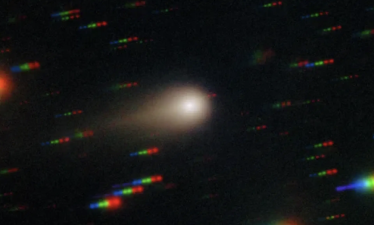
NASA’s SPHEREx space telescope has observed interstellar comet 3I/ATLAS during its passage through the solar system, detecting a brightening coma and chemical signatures linked to volatile ices and organic compounds. The observations add to the scientific record on only the third known interstellar object to be identified entering our solar system. The findings are important for understanding the composition of material formed around other stars and how such bodies evolve after long exposure to deep space.
Discovery and Interstellar Nature
Comet 3I/ATLAS was first identified by the NASA-funded ATLAS survey telescope in Chile in July 2025. Scientists confirmed its interstellar origin from its unusually high speed and trajectory. Since then, multiple NASA missions have tracked its path and studied its changing activity as it moved through the inner solar system.
Chemical Signatures Detected
SPHEREx detected organic molecules including methanol, cyanide and methane in the comet’s coma. It also observed large amounts of carbon dioxide, with smaller quantities of carbon monoxide and water. These substances are released when sunlight heats the comet and causes frozen material to sublimate directly from solid to gas.
Delayed Outgassing and Brightening
The comet became brighter after passing closest to the Sun. Scientists link this delayed increase to heat penetrating deeper layers of the nucleus over time. As subsurface ice warmed, it released water ice, carbon-rich material, dust and rocky grains. The activity suggests the comet had a radiation-processed crust, while more pristine material remained buried below the surface.
Scientific Importance of SPHEREx
SPHEREx is designed to map the sky in 102 infrared colours and study the origins of the universe, galaxies and life-related ingredients in the Milky Way. Its wide-field view allowed it to capture 3I/ATLAS as a valuable side observation. The dataset is freely available and supports broader research on comets, asteroids and near-Earth objects.
Last Modified: April 27, 2026