
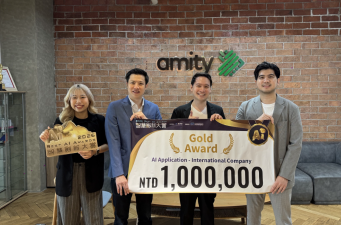
Amity’s AI Research and Application Center (ARAC), headquartered in Singapore, won the Gold Award in the AI Application (International Company) category at the 2026 Best AI Awards in Taipei, Taiwan. Backed by Taiwan’s Ministry of Economic Affairs (MOEA) and organized by the Department of Industrial Technology (DoIT), the competition recognizes technical innovation and commercial value in artificial intelligence projects. Amity secured the top prize of 1,000,000 New Taiwan Dollars after competing against more than 100 international organizations. The winning enterprise-grade product, Eko Agentic: Data Analyst, uses a continuous loop of perception, planning, and action to support autonomous multi-step workflows in business environments.
Understanding Agentic Artificial Intelligence
Definition and Core Concept
Agentic Artificial Intelligence refers to advanced AI systems that possess agency—the capacity to act independently, make decisions, and achieve specific goals with minimal human supervision. Traditional generative AI responds to individual user prompts to create content or analyze static data. Agentic AI moves beyond single-shot responses by breaking down complex objectives into sequential tasks, interacting with external digital systems, and adapting to changing variables in real time.
Core Components of Agentic Architecture
- Perception: The system ingests and processes heterogeneous data from sensors, databases, application programming interfaces (APIs), and user interfaces to comprehend its operational environment.
- Reasoning and Planning: Using a large language model (LLM) as its cognitive engine, the system interprets context, evaluates potential solutions, and formulates a multi-step execution plan.
- Action: The system executes tasks autonomously across underlying applications by calling external tools, updating files, or communicating with other software systems.
- Reflection and Learning: Post-execution, the agent assesses the outcome against the target goal. Through feedback loops and reinforcement learning, it refines its strategy for future tasks.
Technical Breakthroughs and Frameworks
Training Methodologies
The commercial scalability of agentic systems relies on specialized alignment and optimization algorithms. For instance, the award-winning Eko Agentic platform employs a three-step training loop: learning from top-performing human operators, utilizing auto-refinement for localized environments, and applying Multi-Turn Group Relative Policy Optimization (MT-GRPO). MT-GRPO is an advanced reinforcement learning algorithm that refines model responses across extended multi-turn interactions, optimizing decision-making without requiring massive compute resources.
Generative AI versus Agentic AI
The shift from foundational models to agentic ecosystems marks an architectural transition from content generation to autonomous orchestration.
| Structural Attribute | Generative AI | Agentic AI |
| Operational Trigger | Single prompt dependent | Goal-driven initialization |
| Workflow Capability | Single-shot output | Multi-step autonomous planning |
| Tool Integration | Limited to internal training data | Active execution via external APIs and tools |
| Memory Management | Ephemeral or session-bounded | Persistent short-term and long-term memory |
| Human Supervision | Continuous human-in-the-loop | Human-on-the-loop (oversight and approval) |
Industrial and Commercial Applications
Enterprise Retail Operations
Agentic systems act as autonomous digital analysts in corporate supply chains. In retail deployments spanning over 1,000 storefronts, agents generate automated daily briefs that identify inventory issues. The system pinpoints the root causes of dead stock, empty shelves, or mistimed promotional campaigns and initiates corrective logistics orders independently.
Diverse Sector Deployment
- Supply Chain Management: Optimizes transit routes, predicts localized demand spikes, and automates warehouse replenishment cycles by evaluating real-time freight data.
- Financial Services: Orchestrates continuous fraud detection, executes algorithmic portfolio rebalancing, and manages compliance workflows across international regulatory frameworks.
- Healthcare Administration: Synthesizes electronic health records, flags drug-to-drug interactions, and assists clinical researchers by managing multi-step data extractions from trial registries.
- Software Engineering: Automates end-to-end debugging pipelines where specialized agents write code, execute test suites, analyze error logs, and deploy patches autonomously.
IASPOINT Booster Facts for UPSC
- Taipei Computer Association (TCA): Established in 1974, TCA is the leading industrial organization in Taiwan representing information technology and communications companies. It hosts major global technology forums, including Computex Taipei.
- Orchestration Layer: The specialized software architecture that manages permissions, security guardrails, memory allocation, and failure events when multiple AI agents interact in a decentralized network.
- Large Action Models (LAMs): A novel class of foundational models engineered specifically to understand human intentions and structural interfaces, allowing them to execute complex tasks on apps and websites directly.
- Coefficient of Restitution (AI Analogy): In physics simulators built using AI libraries like Matter.js, this coefficient determines bounce elasticity. In agentic AI optimization, comparable parameters measure how flexibly an agent bounces back from execution failures or network timeouts.
- Vertical AI: Highly specialized AI models trained on sector-specific proprietary data (e.g., retail, telecom, or legal frameworks) rather than generic, cross-domain public text.