
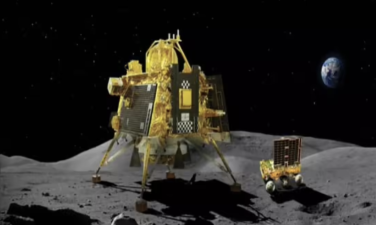
India’s first lunar sample return mission, Chandrayaan-4, has identified a promising landing zone in the Moon’s south polar region. Scientists at ISRO’s Space Applications Centre have shortlisted a one-square-kilometre patch near Mons Mouton as the safest candidate for touchdown after analysing high-resolution terrain data from Chandrayaan-2’s Orbiter High Resolution Camera.
Site Selection for Chandrayaan-4
Chandrayaan-4 is planned as ISRO’s most complex lunar mission. It will involve a propulsion module, descender module, ascender module, transfer module and re-entry module. The mission aims to soft-land on the Moon, collect samples, launch them back into lunar orbit and return them to Earth.
Why the South Polar Region Matters
The lunar south pole is scientifically important but difficult for landing. The terrain is rugged, uneven and partly shadowed. Engineers require:
- Gentle local slopes, ideally within about 10°.
- Clear radio visibility to Earth.
- Sunlight for about 11-12 days.
- Minimal hazards such as craters and boulders.
How the Landing Zone Was Studied
Researchers used stereo images from the OHRC with 32-centimetre resolution. They created digital elevation models at a 0.32-metre grid scale and studied slope, illumination and hazard patterns. Five zones around Mons Mouton were examined, but one was rejected because it lay in permanent shadow.
Why MM-4 Emerged as the Best Option
Among the shortlisted sites, MM-4 performed best. It is located at latitude minus 84.289° and longitude 32.808°. The site recorded:
- The lowest hazard level at 9.89%.
- An average slope of 5°.
- The highest number of safe landing grids, at 568.
- Favourable illumination with limited shadowing.
Other sites had higher hazard levels or fewer safe grids. If approved, MM-4 could host India’s first lunar sample return landing attempt.
Last Modified: April 28, 2026