
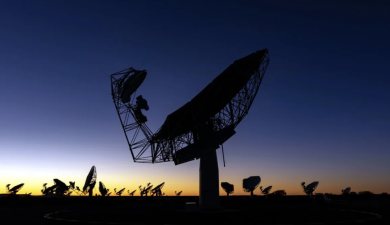
A South African radio telescope has detected an exceptionally distant hydroxyl megamaser in a violent galaxy merger more than 8 billion light-years away. The discovery pushes the known limits of such radio emissions and marks the growing role of high-sensitivity instruments in deep-space astronomy. The source, HATLAS J142935.3–002836, is now described as a gigalaser because of its extraordinary luminosity.
What Was Discovered
- The object is a hydroxyl megamaser, or OHM, a powerful radio emission produced in gas-rich galaxy collisions.
- The emission comes from hydroxyl molecules amplified by dense gas compressed during the merger.
- The detected signal is the most distant and energetic example of this phenomenon so far observed.
Role of MeerKAT
- The detection was made using the MeerKAT radio telescope in South Africa.
- MeerKAT’s sensitivity at centimetre wavelengths helped identify the faint signal.
- Advanced algorithms and computing support improved the data analysis and detection process.
- The observation required only 4.7 hours, showing the telescope’s efficiency.
Gravitational Lensing Effect
- The signal was further magnified by a massive foreground galaxy.
- This effect is known as gravitational lensing.
- The lensing galaxy acted like a cosmic telescope by bending space-time and amplifying the distant radio source.
- The discovery demonstrates how natural cosmic alignment can aid astronomical observation.
Scientific Significance
- The detection extends previous OHM survey limits from redshift z = 0.25 to z = 1.027.
- It also revealed a previously unknown neutral atomic hydrogen absorption line.
- The finding supports future research using MeerKAT and the Square Kilometre Array.
- It shows the value of combining advanced instruments, data pipelines, and skilled scientific teams.