
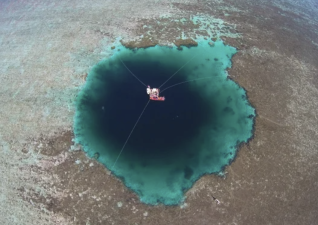
The Sansha Yongle Blue Hole, also called the Dragon Hole, is one of the most unusual marine features in the South China Sea. Once regarded as the deepest known blue hole, it remains scientifically important because of its complex shape, isolated water layers and clues to past sea-level change. Its study has helped researchers better understand how blue holes form and how they preserve environmental history.
What Makes the Dragon Hole Unique
The Dragon Hole is not a simple vertical shaft. It bends and tilts as it descends, and the deepest point lies more than 100 metres sideways from the surface opening. The upper section is broad, while deeper parts narrow sharply before widening again in places. This uneven structure suggests a long geological history rather than a single collapse.
How Its Depth Was Measured
Earlier attempts to measure the hole were difficult because the walls and angles confused navigation systems. In 2017, scientists used an advanced underwater robot with precise navigation tools to map the interior in three dimensions. The final confirmed depth was 301.19 metres, with very small uncertainty. This made it one of the best-mapped blue holes in the world.
Clues from Rock and Water
The walls contain ledges and step-like features that likely reflect ancient sea levels during colder periods when ocean levels were lower. Reef limestone dominates the structure, with side cavities visible at different depths. These features indicate that the hole developed gradually as sea levels changed over time.
Scientific Importance of Low Oxygen Layers
Below about 90 to 100 metres, oxygen levels fall sharply and nearly disappear. Deeper water becomes still, with little mixing from the surrounding sea. Hydrogen sulphide is also present in lower layers. This isolation makes the Dragon Hole valuable for studying past ocean conditions, chemical change and the limits of marine life.
Last Modified: April 28, 2026