
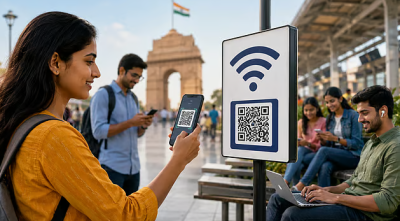
The Department of Telecommunications (DoT) has issued fresh policy directives via Circular Nos. 1/PM-WANI/2026 and 2/PM-WANI/2026 to overhaul the Prime Minister’s Wi-Fi Access Network Interface (PM-WANI) architecture. The targeted framework aims to dismantle existing operational barriers by streamlining public authentication mechanisms, introducing micro-validity billing formats, and eliminating structural safety risks linked with counterfeit networks. Directed under the Digital India objective to build ubiquitous internet utilities, the DoT has mandated a strict eight-week implementation window for all registered service delivery operators, targeting full nationwide compliance by July 2026.
Core Structural Reforms (2026 Directives)
QR Code-Based Secondary Authentication
Connecting external hardware components like laptops and tablets previously depended on redundant One-Time Password (OTP) verification routines over cellular networks. The revised guidelines permit users to register secondary computing devices instantly by executing a single scan of a dynamic QR code using a pre-authenticated mobile handset application. This process completely bypasses commercial SMS-gateways, eliminating login delays caused by cellular network drops.
Sachet-Style Micro Data Plans
To align connectivity costs with transient usage, the updated structural model shifts away from mandatory multi-day subscriptions toward high-speed, micro-duration data packets. Hotspot aggregators are instructed to offer targeted data bursts under specialized validity structures:
- 15-Minute Sachet: Configured for high-speed document retrievals, transit ticketing, or immediate checking of travel updates.
- 30-Minute Sachet: Designed for mid-transit commuters at railway terminals and state transport hubs.
- 60-Minute Sachet: Optimized for students, digital professionals, and low-wage daily laborers operating within public spaces.
Standardized SSID Nomenclature
Unregulated deployment of public access spots often leads to visual confusion and distinct security threats like data scraping or digital phishing exploits. The DoT has legally mandated that Service Set Identifiers (SSIDs)—the broadcast names visible on user devices—must follow a uniform “PMWANI” branding architecture. This creates an immediate visual distinction between verified public digital public infrastructure (DPI) channels and unverified private or commercial open routers.
Architectural Pillars of the PM-WANI Framework
The underlying PM-WANI network functions via an unbundled, decentralized delivery chain designed to democratize public bandwidth without requiring massive corporate capital outlays.
| Ecosystem Component | Core Functional Mandate | Legal / Operational Status |
| Public Data Office (PDO) | Establishes physical Wi-Fi deployment terminals; procures raw backhaul bandwidth from local internet service providers. | Requires zero registration fees or regulatory licensing from the DoT. |
| Public Data Office Aggregator (PDOA) | Performs systemic functions including authorization, access management, accounting, and institutional billing settlement. | Obligated to register formally with the DoT via the SARAL संचार portal. |
| App Provider | Develops citizen-facing mobile applications to execute user discovery, profile registration, and payment processes. | Requires central registration with the DoT; must maintain absolute interoperability across all active PDOAs. |
| Central Registry | Maintains the architectural metadata of the entire ecosystem; managed continuously by C-DOT. | Verifies system-wide credential compliance and tracks active operational components. |
Strategic Socio-Economic Imperatives
Closing Last-Mile Connectivity Gaps
Fixed-line fiber deployments inside rural settlements or congested urban clusters involve high structural capital expenditure. PM-WANI utilizes existing commercial broadband infrastructure to distribute short-range wireless access points, acting as a functional utility tool that lowers the cost of retail internet consumption.
Promotion of Local Entrepreneurship
By removing registration costs and commercial licensing protocols for small merchants, local kirana storefronts, tea stalls, and village common service centers can set up individual PDO operations. This creates an additional micro-revenue system for small scale businesses.
Enhancing Digital Public Infrastructure (DPI) Integrity
Integrating standardized SSIDs provides a secure access network layer. It allows citizens to safely interact with India’s broader DPI assets—such as the Unified Payments Interface (UPI), DigiLocker, and e-Sanjeevani—without exposing data credentials to malicious lookalike third-party networks.
IASPOINT Booster Facts for UPSC
- Launch Background: The Union Cabinet approved the PM-WANI framework in December 2020 based on recommendations originally submitted by the Telecom Regulatory Authority of India (TRAI).
- Regulatory Relaxation: Under the National Digital Communications Policy objectives, PDOs are completely exempted from payment of spectrum usage charges, entry fees, or annual revenue-sharing percentages.
- Central Custodian: The Centre for Development of Telematics (C-DOT) functions as the sovereign body maintaining the Central Registry architecture, ensuring absolute interoperability across multiple service providers.
- Statistical Footprint: Official data indicates that the PM-WANI framework crossed a milestone of over 4,09,403 operational Public Data Offices (PDOs) nationwide.
- Hardware Framework: Access points typically utilize license-exempt Wi-Fi frequency bands operating at standard 2.4 GHz and 5 GHz wave profiles to optimize local coverage zones.