
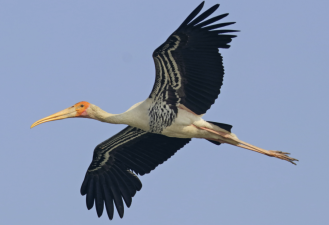
A team of researchers has used deep transfer learning and computer vision to study nest site fidelity in a painted stork at the National Zoological Park, Delhi. The non-invasive method identified an individual bird, nicknamed Ringo, through a distinctive neck scar and wing-pattern features. The bird was monitored across four breeding seasons from 2022 to 2025. The study demonstrates how artificial intelligence can support long-term wildlife observation without disturbing animals.
Study Focus
The research examined nest site fidelity, the tendency of a bird to return to the same nesting site in successive breeding seasons. Ringo, a male painted stork, was repeatedly sighted at the same location over four years. This provided evidence of strong site fidelity in a colonial waterbird species.
Method Used
Researchers collected 2,349 high-resolution images of Ringo and 1,755 images of other nesting storks. The images captured both sides of the body and folded wing markings. They used the scale-invariant feature transform, or SIFT, to detect distinctive visual features. A deep transfer learning model then matched the bird’s feather pattern and scar marking with high accuracy. The system validated Ringo’s identity with 98% accuracy.
Scientific Significance
The findings show that pattern-based recognition can function as a biological fingerprint for individual birds. The approach is non-invasive, making it useful for studying sensitive species and breeding colonies. It also reduces the need for physical tagging, which can stress birds or alter behaviour. Such tools can improve ecological monitoring, population studies, and conservation planning.
Broader Relevance
The study marks the growing role of artificial intelligence in wildlife science. It is especially relevant for monitoring colonial waterbirds, where repeated visual identification is difficult. The method may be adapted for other species with unique plumage, scars, or body patterns. It also reflects the increasing use of digital tools in biodiversity research and environmental management.
Last Modified: April 29, 2026