
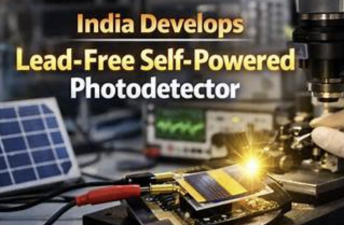
Researchers in India have developed a lead-free, environmentally friendly photodetector that works without external power and shows long-term stability. The device is based on the double perovskite material Cs2AgBiBr6 and has been designed for use in cameras, smart wearables, industrial sensors, security systems and biomedical imaging. The innovation is because it offers an alternative to toxic lead-based perovskite devices, which are efficient but raise environmental and health concerns.
What the Device Does
Photodetectors convert light into electrical signals. They are widely used in imaging systems, optical sensors and electronic devices. The new device responds strongly to visible light and operates in a self-powered mode. This means it does not need an external voltage source to function.
Key Features of the Design
- The photodetector uses lead-free Cs2AgBiBr6, which reduces toxicity concerns.
- It is hole-transport-material-free, which simplifies the structure.
- It uses low-cost carbon electrodes instead of expensive metal contacts.
- It is fabricated at room temperature through a single-step coating process.
- The device can be made under ambient conditions, without gloveboxes or vacuum systems.
Performance and Stability
The device showed consistent ON-OFF switching behaviour during testing. It retained over 90 per cent of its performance after 60 days of storage under normal room conditions. This indicates strong environmental stability, which is essential for practical deployment in real-world settings. The close match between initial and later performance measurements confirms its reliability.
Significance for India
The development supports low-cost and sustainable electronics manufacturing. It also aligns with India’s goals of green technology, advanced materials research and self-reliance in electronic components. The study was supported by the Department of Science and Technology and published in Solar Energy.
Last Modified: April 27, 2026