
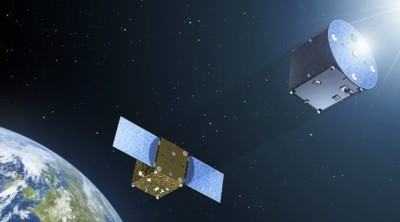
The European Space Agency’s Proba-3 mission, designed to study the Sun’s corona through precision formation flying, has suffered a serious setback after one of its two spacecraft lost contact. The affected Coronagraph spacecraft experienced an onboard anomaly that led to progressive loss of attitude control, battery drain, and entry into survival mode. The mission remains under investigation, while the healthy Occulter spacecraft is being considered for support in recovery efforts.
What Happened
An anomaly in the Coronagraph spacecraft triggered a chain of events that disrupted its orientation in space. As a result, its solar panels no longer faced the Sun properly. The battery began to discharge rapidly, forcing the spacecraft into survival mode. In this state, only minimum systems remain active and communication with Earth is interrupted.
Why Proba-3 Is Important
Proba-3 is a unique solar observation mission. It uses two satellites, the Coronagraph and the Occulter, to create artificial solar eclipses in orbit. This allows scientists to observe the Sun’s corona, its outer atmosphere, in exceptional detail. The spacecraft must fly in highly precise formation, separated by about 150 metres, to block the Sun’s bright disc and study the faint corona.
Mission Progress Before the Anomaly
Since its launch in December 2024, Proba-3 had completed more than 60 accurate formation-flying orbits. These operations demonstrated advanced spacecraft coordination and generated several hours of science data per orbit. The mission was considered a major milestone in space-based solar research and autonomous formation flying.
Recovery Efforts and Scientific Significance
Mission teams are examining whether the Occulter spacecraft can safely approach the Coronagraph and help determine its orientation. The root cause of the anomaly is still unknown. The mission’s recovery is important because Proba-3 represents a breakthrough in precision space engineering and solar physics, with potential applications for future multi-spacecraft missions.
Last Modified: April 28, 2026