
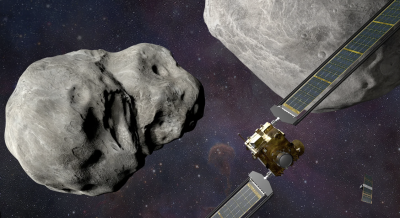
NASA’s Double Asteroid Redirection Test (DART) has been found to have done more than change the path of a small asteroid. The impact also slightly altered the orbit of the entire Didymos-Dimorphos system around the Sun. The finding strengthens the case for spacecraft impact missions as a practical planetary defence tool against hazardous asteroids.
DART Mission and Target
The DART spacecraft was deliberately crashed into Dimorphos, a small asteroid orbiting the larger asteroid Didymos. Dimorphos is about 170 metres wide, while Didymos is about 805 metres across. Together, they form a binary asteroid system that does not pose a threat to Earth, making it suitable for testing asteroid-deflection methods.
Historic Collision in Space
In September 2022, DART struck Dimorphos at a speed of about 22,500 km per hour. The mission tested the kinetic impactor technique, in which a spacecraft hits an asteroid to change its motion. The impact successfully shortened Dimorphos’s orbital period around Didymos from 11 hours and 55 minutes to 11 hours and 23 minutes, a reduction of 33 minutes.
New Findings on Solar Orbit
Recent analysis shows that the collision also changed the system’s orbit around the Sun. The solar orbital period shifted by about 0.15 seconds, and the system’s speed changed by roughly 11.7 microns per second. Though tiny, these changes show that a spacecraft impact can measurably alter the motion of celestial bodies.
Why the Result Matters
The impact created a large spray of rocky debris from Dimorphos. This debris acted like natural rocket exhaust and increased the momentum transfer from the spacecraft. The result is important for Earth’s safety because a small deflection, if applied early enough, could move a dangerous asteroid away from a collision course with Earth.
Last Modified: April 28, 2026