
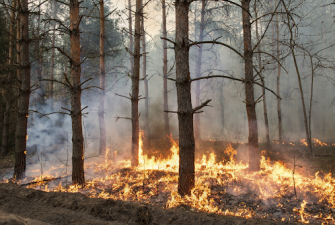
Researchers from the Birbal Sahni Institute of Palaeosciences (BSIP), Lucknow, have uncovered molecular and microscopic evidence of massive wildfires that swept through ancient Gondwana forests approximately 250 million years ago. By analyzing Permian-period, coal-bearing sedimentary layers from the Godavari Valley in Telangana, India, the team successfully differentiated between low- and high-intensity ancient fires. This research provides crucial insights into Earth’s historical climate transitions, carbon cycle fluctuations, and atmospheric composition during a period marked by catastrophic global warming. Methodological Innovations in Palaeofire Reconstruction Historically, identifying ancient forest fires relied heavily on finding macro-charcoal chunks (fossilized wood fragments). However, these physical structures degrade easily over millions of years. To circumvent this, the BSIP researchers integrated microscopic organic analysis with advanced molecular spectroscopy to identify and classify microcharcoal particles.
1. Palynofacies Analysis
Palynofacies involves the study of all acid-resistant organic matter (such as pollen, spores, fungal remains, and structured or unstructured organic debris) extracted from sedimentary rocks using microscopy.
- Through this process, scientists can identify inertinite—a group of coal macerals (organic components) formed specifically through the thermal alteration and charring of plant tissue during wildfires.
2. FTIR (Fourier-Transform Infrared) Spectroscopy
FTIR spectroscopy measures how organic matter absorbs infrared light. This allows scientists to identify specific chemical functional groups.
- Low-Intensity Fire Signatures: Organic material exposed to lower temperatures retains a higher proportion of aliphatic bonds (C-H chains) and functional groups containing oxygen (C = O or -OH).
- High-Intensity Fire Signatures: Intense heat strips away these weaker bonds, leaving behind highly condensed, stable aromatic ring structures (C = C).
3. Raman Spectroscopy
Raman spectroscopy uses laser light to analyze the vibrational and structural arrangements of carbon molecules. It assesses the structural ordering of microcharcoal.
- As wildfire temperatures increase, the charred organic matter undergoes a structural transition, becoming more ordered and crystalline (graphite-like).
- Measuring the ratio between disordered carbon bonds (D-band) and ordered graphitic carbon bonds (G-band) allows researchers to precisely calculate the minimum temperature at which the ancient vegetation burned.
Key Scientific Findings
- Evidence of High-Intensity Pyrolysis: The spectroscopy data revealed highly aromatic, structurally ordered microcharcoal. This proves that the ancient Gondwana forests experienced extreme, high-intensity canopy and ground fires rather than just minor, low-temperature surface smoldering.
- Climatic Drivers: The prevalence of these massive Permian wildfires points toward a highly seasonal climate characterized by prolonged dry spells, low ambient humidity, and elevated atmospheric oxygen levels, which collectively created a hyper-flammable environment.
- The Godavari Valley Baseline: The coal-bearing sediments of the Pranhita-Godavari basin serve as an exceptional geological repository, preserving the atmospheric and ecological shifts that occurred just prior to the Permian-Triassic mass extinction event.
Global and Future Ecological Implications
Understanding Deep-Time Climate Change
The Permian period concluded with the earth’s most devastating mass extinction event, largely driven by massive volcanic eruptions (the Siberian Traps) that pumped greenhouse gases into the atmosphere. The BSIP study demonstrates that massive forest fires acted as a severe feedback loop—releasing massive pulses of biogenic CO2 into the atmosphere, accelerating global warming, and stripping land ecosystems of stabilizing vegetation.
Improving Modern Climate Models
By mapping how ancient ecosystems responded to sudden spikes in wildfire activity, climate scientists can refine predictive models for contemporary global warming. The data helps quantify how modern forest ecosystems might transform, sink, or release carbon as global temperatures rise and wildfire frequencies accelerate. IASPOINT Booster Facts for UPSC
- Birbal Sahni Institute of Palaeosciences (BSIP): Located in Lucknow, Uttar Pradesh, BSIP is an autonomous institute functioning under the Department of Science and Technology (DST), Government of India. It was founded in 1946 by the renowned Indian botanist Professor Birbal Sahni to dedicate research to plant fossils and deep-time geology.
- Gondwana Supercontinent: A massive ancient supercontinent that broke apart around 180 million years ago. It included modern-day India, Africa, South America, Australia, Antarctica, and Madagascar. The Indian landmass contains extensive “Gondwana Coalfields” (accounting for over 98% of India’s metallurgical and thermal coal reserves), heavily concentrated in the Damodar, Mahanadi, Son, and Godavari river valleys.
- Permian Period: The final geological period of the Paleozoic Era, spanning from roughly 299 to 251 million years ago. It concluded with the Permian-Triassic Extinction Event (often called the “Great Dying”), which wiped out over 90% of marine species and 70% of terrestrial vertebrate species.
- Macerals: The microscopic, organic components of coal, analogous to “minerals” in inorganic rocks. They are divided into three main groups based on their plant origin and thermal history: Vitrinite (derived from cell walls and woody tissues), Liptinite (derived from spores, resins, and cuticles), and Inertinite (derived from strongly charred or oxidized plant material, indicative of palaeofires).