
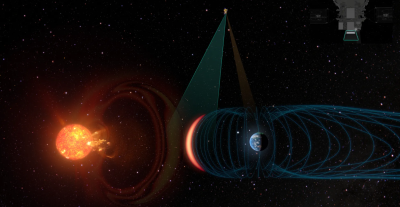
The Solar wind Magnetosphere Ionosphere Link Explorer (SMILE) spacecraft successfully lifted off on May 19, 2026, aboard a Vega-C rocket from Europe’s Spaceport in Kourou, French Guiana. This space exploration venture is a joint initiative developed by the European Space Agency (ESA) and the Chinese Academy of Sciences (CAS). The primary purpose of the three-year mission is to investigate the continuous interaction between Earth’s protective magnetic shield, known as the magnetosphere, and supersonic solar winds. By capturing the first-ever soft X-ray images of this cosmic collision, the mission aims to provide deep insights into space weather phenomena, enhancing early forecasting systems for solar storms that threaten global satellite communications, navigation systems, and power grids.
Core Objectives of the Mission
The spacecraft is designed to address fundamental mysteries regarding near-Earth space environments.
Mapping the Solar Wind Boundary
SMILE will observe the exact mechanisms occurring where solar wind particles hit the outermost edge of Earth’s magnetic field, called the magnetopause. This will track how energy and plasma transfer from the Sun into the geomagnetic bubble.
Analyzing Magnetospheric Dynamics
The mission will investigate the plasma physics behind magnetic reconnection. This process causes sudden changes on the night-side of Earth’s magnetosphere, driving geomagnetic substorms.
Aurora Formation Correlation
By coordinating dual-wavelength observations, the mission will map how dynamic variations in the distant magnetosphere trigger intense auroral displays in the upper atmosphere.
Spacecraft Orbit and Trajectory
The satellite relies on a specific orbital configuration to sustain continuous scientific observations.
- Elliptical Profile: SMILE travels along a highly inclined, highly elliptical polar orbit around Earth.
- Apogee Parameters: At its highest point over the North Pole, the satellite reaches an altitude of 121,000 kilometers. This extreme distance represents nearly one-third of the distance to the Moon.
- Perigee Parameters: At its lowest point, the spacecraft dips to 5,000 kilometers over the South Pole. This allows the satellite to transmit scientific data efficiently to ground stations like the Bernardo O’Higgins research station in Antarctica.
- Observation Window: The northern orbit allows the spacecraft to observe Earth’s northern lights continuously for 45 hours at a time during its 48-hour orbital period.
- Radiation Mitigation: The design ensures that the spacecraft minimizes its time spent traversing the high-radiation zones of the Van Allen belts.
Scientific Payloads and Instruments
The spacecraft carries a payload totaling 70 kilograms, consisting of four specialized scientific instruments split between remote-sensing cameras and in-situ particle detectors.
Soft X-ray Imager (SXI)
Developed primarily by European institutions, this wide-field telescope uses innovative lobster-eye optics to capture the soft X-ray emissions generated when solar wind ions collide with Earth’s neutral atmosphere. This will map the shape and movement of the magnetopause boundary.
Ultraviolet Imager (UVI)
Provided by Chinese researchers, this camera focuses on Earth’s polar regions to capture continuous, high-temporal-resolution images of the aurora borealis in ultraviolet wavelengths.
Light Ion Analyser (LIA)
This in-situ detector features two sensors mounted on the main platform. It measures the velocity, density, and distribution of low-energy ions within the solar wind and magnetosheath regions.
Magnetometer (MAG)
This instrument utilizes two magnetic sensors placed 80 centimeters apart on a deployable 3-meter-long boom. It measures the ambient magnetic field vector to detect the passage of solar shocks and interplanetary waves.
Architectural Breakdown of Collaborative Responsibilities
The institutional division of labor highlights the operational structure of this collaborative space mission.
| Mission Component | Responsible Agency / Partner |
| Launch Vehicle & Service | European Space Agency (ESA) via Vega-C Rocket |
| Payload Module Procurement | European Space Agency (ESA) |
| Spacecraft Platform & Bus | Chinese Academy of Sciences (CAS) |
| Scientific Operations | Jointly managed by ESA and CAS |
| Soft X-ray Imager (SXI) | Led by United Kingdom & European Partners |
| Ultraviolet Imager (UVI) | Chinese Academy of Sciences (CAS) |
| Light Ion Analyser (LIA) | Chinese Academy of Sciences (CAS) |
| Magnetometer (MAG) | Chinese Academy of Sciences (CAS) |
IASPOINT Booster Facts for UPSC
- Historical Milestone: SMILE represents the first time that ESA and China have jointly selected, designed, implemented, launched, and operated a space science mission together from inception.
- Precursor Missions: The data gathered builds upon the scientific heritage of earlier ESA programs, such as the Cluster mission (which used four identical satellites to map the magnetosphere in 3D) and the XMM-Newton X-ray observatory.
- The X-ray Mechanism: The mission relies on a physical phenomenon called Solar Wind Charge Exchange (SWCE). This occurs when highly charged solar wind ions extract electrons from neutral hydrogen atoms in Earth’s exosphere, emitting soft X-ray photons in the process.
- Space Weather Vulnerability: Precise space weather tracking helps safeguard critical infrastructure on Earth, including Global Navigation Satellite Systems (GNSS), trans-polar aviation routes, high-voltage electrical transformers, and the safety of astronauts in Low Earth Orbit (LEO).