
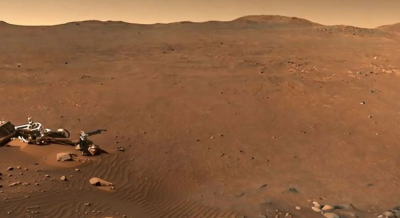
NASA’s Perseverance rover recently captured a detailed 360-degree panoramic image of a unique rocky formation named “Crocodile Bridge,” located on the rim of Jezero Crater on Mars. The high-resolution image was compiled from a series of photographs taken between December 2025 and January 2026 using the rover’s advanced Mastcam-Z camera system. This specific formation sits in close proximity to an area designated as Lac de Charmes, which represents the next major exploration target for the mission. The geological composition of this region offers critical evidence regarding early Martian climate, ancient surface water systems, and the past habitability of the planet.
Geological Framework of Jezero Crater
Jezero Crater is a massive impact basin located at the edge of the Isidis Planitia impact structure. It serves as a primary natural laboratory for studying planetary evolution and ancient hydrologic systems.
Topography and Ancient Hydrology
- Origins: The crater was formed by a meteor impact approximately 3.9 to 4 billion years ago.
- The Paleolake: During the Noachian and early Hesperian epochs, the crater housed a lake measuring roughly 35 kilometers in diameter.
- Inflow Channels: Two distinct river channels, Neretva Vallis and Sava Vallis, breached the crater rim to deposit water and sediments into the basin.
- Delta Formation: The inflow created a prominent fan-shaped river delta rich in clay minerals and carbonates, which are excellent preservation agents for organic matter.
Absence of Tectonic Activity
Unlike Earth, Mars lacks a system of active, moving tectonic plates. This absence of crustal recycling means the ancient surface features, volcanic plains, and impact basins inside Jezero Crater have remained largely undisturbed for billions of years, offering an unaltered record of the early Solar System.
Technology and Instrumentation: Mastcam-Z
The discovery and documentation of the Crocodile Bridge formation relied entirely on the high-definition imaging capabilities of the Perseverance rover.
Technical Specifications of Mastcam-Z
- System Type: A multispectral, stereoscopic imaging instrument mounted on the rover’s remote sensing mast.
- Zoom Capability: Features a powerful zoom lens that can capture 3D color images and videos at varying focal lengths.
- Scientific Utility: It helps scientists determine the mineralogy of rocks and soils while assisting engineers in plotting safe navigation routes across the rugged crater terrain.
Mission Objectives and Future Exploration Targets
The Mars 2020 mission utilizes Jezero Crater as a stepping stone to answer fundamental questions about astrobiology and planetary history.
Exploration at Lac de Charmes
The rover is transitioning toward Lac de Charmes, a region situated along the crater rim. This area contains diverse rock layers that predate the actual crater impact. Investigating these formations helps scientists understand the baseline composition of the Martian crust before the water systems developed.
The Mars Sample Return Program
Jezero Crater was specifically chosen because its rocks can answer whether life ever existed on Mars. Perseverance is actively collecting and caching rock cores and soil samples. The joint NASA-ESA Mars Sample Return program intends to deploy subsequent missions to retrieve these sealed tubes and bring them back to Earth for advanced laboratory analysis.
| Key Mission Phase | Timeline / Target | Primary Objective |
| Crater Landing | February 18, 2021 | Touchdown at Octavia E. Butler Landing site inside Jezero Crater. |
| Delta Exploration | 2022 – 2024 | Sampling sedimentary layers for potential biosignatures. |
| Rim Ascent | late 2024 – 2025 | Climbing out of the crater floor to study ancient basement rocks. |
| Crocodile Bridge Imaging | Dec 2025 – Jan 2026 | Comprehensive mapping of the crater rim geology. |
| Lac de Charmes Route | Mid-2026 onward | Investigating pre-impact crustal materials and mineral diversity. |
IASPOINT Booster Facts for UPSC
- The Meaning of Jezero: The crater is named after the town of Jezero in Bosnia and Herzegovina. The word “jezero” translates to “lake” in several Slavic languages, directly referencing its ancient geology.
- Ingenuity Mars Helicopter: Perseverance traveled to Mars with a companion technology demonstrator named Ingenuity. It became the first aircraft to achieve powered, controlled flight on another planet, operating from 2021 until early 2024.
- MOXIE Experiment: The rover also carried the Mars Oxygen ISRU Experiment (MOXIE), which successfully extracted pure oxygen from the carbon dioxide-dominant Martian atmosphere, proving the viability of In-Situ Resource Utilization (ISRU) for future human missions.
- Martian Geological Epochs: Mars’ history is divided into three major eras based on crater density: Noachian (oldest, wettest period), Hesperian (transition to widespread volcanism), and Amazonian (coldest, driest, modern period).