
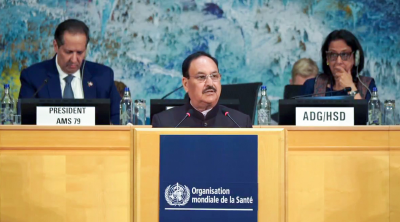
At the 79th World Health Assembly in Geneva, Switzerland, India showcased its dual advancements in healthcare: the National Tuberculosis Elimination Programme and a national vision for ethical Artificial Intelligence (AI). Addressing high-level side events, including one organized by the Stop TB Partnership, the Indian delegation shared its extensive house-to-house screening campaigns and decentralized molecular diagnostic deployments. The address detailed how frontier technologies are being deployed across 1.4 billion citizens to bridge systemic delivery gaps while adhering to rigorous regulatory frameworks that prevent data biases and ensure public trust.
National Tuberculosis Elimination Programme and Case Finding
India operates one of the largest active case-finding operations globally to locate missing tuberculosis cases, particularly among vulnerable populations. The operational methodology combines systematic technological scaling with direct community outreach.
Screening and Diagnostic Architecture
- Active Case Finding: Frontline healthcare workers conduct door-to-door screening drives, utilizing mobile units and targeted field campaigns in high-risk zones to eliminate delayed detection.
- Modern Diagnostics Infrastructure: The country has decentralized its testing networks by deploying high-throughput molecular testing platforms, digital chest X-rays, and portable screening devices.
- Epidemiological Progress: Over the past decade, India achieved a 21 per cent reduction in TB incidence and a 25 per cent decline in TB mortality, outperforming global averages. Current treatment coverage stands at 92 per cent, reducing undetected annual cases to fewer than one lakh.
TB Mukt Bharat Abhiyaan and Digital Innovations
The Ni-kshay ecosystem forms the core of India’s TB management, integrating corporate and citizen-led social support with advanced AI communication assets to manage patient tracking and nutritional needs.
Community Mobilization and Technological Interface
- Ni-kshay Mitra Initiative: This citizen-centric component allows individuals, institutions, and corporate entities to adopt TB patients, providing additional nutritional, diagnostic, and vocational support to ensure treatment adherence.
- TB Mukt Bharat App: A digital platform designed to operate efficiently on entry-level smartphones, minimizing the literacy and technological access divide.
- Khushi AI Chatbot: An integrated multilingual conversational tool within the application that provides real-time, automated guidance regarding TB symptoms, diagnostic center locations, and state-sponsored financial entitlements.
Strategic Frameworks for Ethical AI in Healthcare
To prevent technology from exacerbating existing health disparities, India has introduced specific administrative frameworks to govern algorithms, ensuring data privacy and safety across 22 official languages.
Strategy for AI in Healthcare for India (SAHI)
Launched at the India AI Impact Summit, SAHI is the first comprehensive framework from the Global South designed for risk-proportionate AI governance. It outlines a structured roadmap to align machine learning tools with verified clinical needs, data transparency, and long-term public health resilience.
Ayushman Bharat Digital Mission (ABDM)
ABDM provides the foundational digital public infrastructure by creating longitudinal electronic health records and national registries of health facilities and professionals. This system uses a strict consent-based architecture, supplying the clean, structured data necessary to develop and train health-sector algorithms.
Benchmarking Open Data Platform for Health AI (BODH)
BODH acts as a safety checkpoint by evaluating newly developed health algorithms against real-world Indian datasets. This benchmarking ensures that predictive tools perform safely, accurately, and equitably across diverse demographic variations before deployment.
Institutional Mechanisms and Policy Milestones
| Framework / Initiative | Implementing Agency | Core Objective |
|---|---|---|
| National Tuberculosis Elimination Programme (NTEP) | Ministry of Health and Family Welfare | Attainment of a TB-free India through universal access to free quality diagnostics and treatment. |
| Strategy for AI in Healthcare for India (SAHI) | Ministry of Health and Family Welfare & NITI Aayog | Establishing ethical oversight and deployment guidelines for health algorithms. |
| Ayushman Bharat Digital Mission (ABDM) | National Health Authority (NHA) | Development of interoperable digital health infrastructure and consent-driven registries. |
| BODH Platform | Ministry of Health and Family Welfare | Standardizing, validating, and benchmarking medical AI models against diverse population data. |
IASPOINT Booster Facts for UPSC
- World Health Assembly (WHA): The supreme decision-making body of the World Health Organization (WHO), attended by delegations from all member states in Geneva annually to determine policies and approve budgets.
- Stop TB Partnership: Formed in 2000, this global initiative operates out of Geneva to eliminate tuberculosis as a public health problem, bringing together international organizations, NGOs, and governments.
- Sustainable Development Goal (SDG) 3.3: The United Nations target aims to end the epidemics of AIDS, tuberculosis, malaria, and neglected tropical diseases by 2030; India’s domestic target aims for TB elimination ahead of this schedule.
- Ni-kshay Poshan Yojana: A direct benefit transfer scheme providing a monthly financial incentive of 500 INR to all notified TB patients to cover nutritional expenses during the treatment cycle.
- National Strategy for Artificial Intelligence (2018): Published by NITI Aayog under the theme “#AIforAll,” it identified healthcare as one of the five core focus areas for maximizing social impact through automation.