
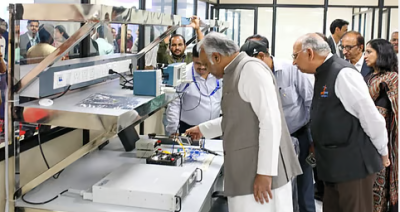
The Karnataka government launched India’s first state-led Centre of Excellence for Space Technology, named the CoE SpaceTech Foundation, in Bengaluru on May 1, 2026. Established through the Karnataka Innovation and Technology Society in collaboration with the SatCom Industry Association of India (SIA-India), the facility operates from Bengaluru’s Aerospace Park. The initiative seeks to bridge the gap between research and development and commercial market deployment within the private space sector. It focuses on accelerating commercial applications of space technologies under the core theme “Space Tech for Societal Impact.”
Institutional Framework and Governance
The CoE SpaceTech Foundation is designed as a collaborative, multi-functional platform bringing together government entities, industry bodies, academia, and startups.
- Implementing Agencies: It is set up by the Department of Electronics, IT, BT, and Science & Technology through the Karnataka Innovation and Technology Society (KITS).
- Industry Partner: Space Industry Association of India (SIA-India) serves as the primary industry collaborator to link public policy with commercial space enterprises.
- Leadership: The foundation operates under the direction of Director DS Govindrajan.
- Core Pillars: The strategic framework of the centre rests on four foundational pillars:
- Training and Capacity Building
- Startup and Incubation Support
- Research and Innovation
- Ecosystem Engagement
Operational Focus and Technical Domains
Operating within the Aerospace Park in Bengaluru, the centre targets specific segments of the space value chain to transition early-stage innovation into scalable commercial solutions.
Technology Sub-sectors
The facility supports research, prototype development, and technical validation across several critical upstream, midstream, and downstream capabilities:
- Satellites and Launch Systems: Engineering support for small satellite development, subsystems, and localized launch vehicle components.
- Remote Sensing and Analytics: Utilizing satellite imagery and space-based data analytics for geographical mapping.
- Space Data Centres and Robotics: Developing localized infrastructure for handling space-generated data and automated robotic applications for orbital or planetary missions.
- Communication Technologies: Advancing satellite-based communication systems, bandwidth optimization, and terrestrial connectivity solutions.
Shared Infrastructure
The government plans to establish a Common Infrastructure Facility (CIF) within the centre. This technical facility will provide shared testing, validation, and advanced manufacturing tools to reduce capital expenditure for early-stage spacetech startups.
Cross-Sectoral and Societal Applications
The operational mandate emphasizes the deployment of space capabilities to solve terrestrial challenges and drive economic outcomes across multiple domains.
| Sector | Specific Space Tech Application |
| Agriculture & Climate | Precision farming, crop yield estimation, soil moisture monitoring, and climate risk modeling via satellite analytics. |
| Disaster Management | Real-time disaster tracking, early warning systems for floods/cyclones, and search-and-rescue mapping. |
| Biotechnology & Healthcare | Microgravity research, in-space biomanufacturing, and advanced pharmaceutical synthesis in low-Earth orbit. |
| Connectivity | Expanding broadband and communication access to remote, underserved regions. |
| National Security | Downstream data intelligence, border surveillance analytics, and strategic situational awareness. |
Strategic Partnerships and MoUs
The CoE formalised multiple domestic and international agreements during its launch to advance interdisciplinary research and commercialisation.
- Manipal Academy of Higher Education (MAHE): Collaboration dedicated to space biology, microgravity studies, student internships, and specialized workforce development.
- Association of Biotechnology Led Enterprises (ABLE): Focused on supporting cross-sector startups combining biotechnology with space environments.
- Helogen Corporation (USA): A strategic international agreement aimed at advancing in-space biomanufacturing for healthcare outcomes.
- Dassault Systèmes & Idea Baaz: Partnerships intended to provide advanced digital modeling, simulation tools, and ecosystem scaling support.
Economic Targets and Policy Alignment
The establishment of the CoE is a localized implementation aligning with the Indian Space Policy, which opened the sector to 100% Foreign Direct Investment (FDI) and enhanced private participation.
- Market Share Goal: The initiative forms part of Karnataka’s strategy to capture 50% of the national space market share, which is projected to reach approximately 22 billion United States dollars by 2033.
- National Contribution: It aims to support India’s national objective of securing 10% of the global space economy within the next decade.
- State Space Innovation Index: The centre intends to introduce India’s first State Space Innovation Index to systematically evaluate policy readiness and the investment climate across provinces.
IASPOINT Booster Facts for UPSC
- Karnataka Innovation and Technology Society (KITS): An autonomous society under the Department of Electronics, IT, BT, and S&T, Government of Karnataka, established to handle incentive schemes, execute policies, and manage incubation centers across the state.
- SIA-India (SatCom Industry Association): A non-profit apex industry association representing the interests of the space domain, including satellite operators, manufacturers, startups, and downstream service providers in India.
- Indian Space Policy: Formulated to transition the role of ISRO from an operational manufacturer to focusing on core R&D, while transferring operational responsibilities to NewSpace India Limited (NSIL) and regulatory roles to IN-SPACe.
- In-Space Biomanufacturing: The practice of manufacturing biological products, tissues, or pharmaceuticals in microgravity environments, where the lack of gravity alters fluid dynamics and cellular growth patterns, allowing for superior crystalline structures and cell cultures compared to Earth.