
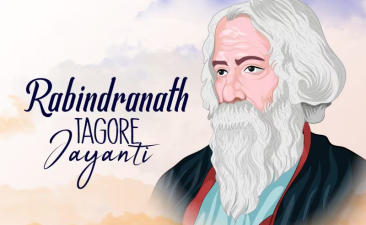
Rabindranath Tagore Jayanti 2026 was observed across India on 7 May, while in West Bengal it was celebrated as Pochishe Boishakh on 9 May. This date corresponds to the 25th day of the Bengali month of Boishakh. The year 2026 marks the 165th birth anniversary of the Bengali poet, writer, composer, and philosopher born in 1861. Cultural organizations commemorated his legacy at his ancestral home, Jorasanko Thakur Bari in Kolkata, Rabindra Sadan, and Santiniketan. The annual event features poetry recitations, musical performances, and literary analysis to honor his contribution to global literature and music.
Historical Context and Early Life
Lineage and Jorasanko Thakur Bari
Rabindranath Tagore was born on 7 May 1861 at Jorasanko Thakur Bari in Calcutta (now Kolkata). He was the youngest son of Debendranath Tagore, a leader of the Brahmo Samaj, and Sarada Devi. The Tagore family stood at the center of the 19th-century Bengal Renaissance. This movement introduced structural changes to Bengali literature, social reform, and education.
Early Education and Literary Initiation
Tagore largely avoided formal schooling, preferring to study at home under private tutors. He explored classical Sanskrit literature, English literature, and western classical music. He published his first collection of poems at the age of 16 under the pseudonym “Bhanusimha” (Sun Lion). These poems mimicked the classical Vaishnava poetry style and became celebrated literary pieces.
Literary Masterpieces and Philosophical Thought
Major Literary Works
Tagore contributed extensively across all major literary genres, introducing colloquial language into traditional Bengali literature.
- Gitanjali (Song Offerings): A collection of deeply spiritual poems published in Bengali in 1910. Tagore translated it into English in 1912 with an introduction by W.B. Yeats.
- Gora: A complex novel addressing themes of identity, orthodoxy, nationalism, and universal humanism during the British Raj.
- Ghare Baire (The Home and the World): A narrative exploring the Swadeshi movement, analyzing the conflict between aggressive nationalism and universal morality.
- Chokher Bali: A novel dealing with widowhood, female literacy, and complex interpersonal relationships in contemporary society.
Philosophical Vision and Humanism
Tagore advocated for universal humanism and spiritual unity rather than rigid nation-state paradigms. He criticized aggressive nationalism, viewing it as a threat to global peace and individual freedom. His philosophy emphasized a synthesis of Eastern spiritual traditions with Western scientific rationale.
Musical Legacy and Cultural Institutions
Rabindra Sangeet
Tagore was a prolific composer who created over 2,200 songs, a distinct genre known as Rabindra Sangeet. These compositions blend classical Indian ragas with traditional folk melodies, particularly Baul music from rural Bengal. The songs cover themes categorized into Pooja (worship), Prem (love), Prakriti (nature), and Swadesh (patriotism).
Transnational Anthems
Tagore holds the unique distinction of composing the musical and lyrical foundations for two distinct national anthems:
| Country | Anthem Title | Year of Composition / Context | Key Features |
| India | Jana Gana Mana | Composed in 1911; first sung at the Calcutta Session of the Indian National Congress. | Written in highly Sanskritized Bengali (Tatsama); adopts five stanzas, with the first stanza serving as the official anthem. |
| Bangladesh | Amar Shonar Bangla | Composed in 1905 during the anti-partition agitation in Bengal. | Inspired by the folk melody of Baul singer Gagan Harkara; adopted as the national anthem in 1971. |
Educational Experiments at Santiniketan
In 1901, Tagore founded an experimental ashram school at Santiniketan, named Patha Bhavana. This school replaced rigid classroom environments with open-air learning under trees, emphasizing a close connection with nature. In 1921, he expanded this institution into Visva-Bharati University, using his Nobel Prize money and global lecture fees. The university developed into a global hub for art, humanity, and cross-cultural studies.
Global Recognition and Political Engagement
The Nobel Prize in Literature
In 1913, Tagore became the first non-European and first Asian to win the Nobel Prize in Literature. The Swedish Academy awarded the prize based on his translated work, Gitanjali. This achievement brought Indian literature to the forefront of international academia and established Tagore as a global cultural envoy.
Renunciation of Knighthood
King George V conferred a knighthood upon Tagore in the 1915 Birthday Honours. Following the Jallianwala Bagh Massacre on 13 April 1919, where British troops fired upon peaceful protestors in Amritsar, Tagore wrote a protest letter to the Viceroy, Lord Chelmsford. He renounced his knighthood to voice his dissent against colonial brutality, a move that gave impetus to the Indian national movement.
IASPOINT Booster Facts for UPSC
- Santiniketan’s UNESCO Status: UNESCO inscribed Santiniketan on the World Heritage List in 2023, recognizing its cultural significance as a center for international humanist values and unique architecture.
- Influence on Sri Lanka’s Anthem: Sri Lanka’s national anthem, Sri Lanka Matha, was composed by Ananda Samarakoon, who studied under Tagore at Santiniketan. The song reflects the musical style and composition layout of Rabindra Sangeet.
- Relationship with Mahatma Gandhi: Tagore bestowed the title “Mahatma” (Great Soul) upon Mohandas Karamchand Gandhi. In return, Gandhi addressed Tagore as “Gurudev” (Divine Teacher). Despite their deep friendship, they publicly debated the merits of nationalism, modern machinery, and the Swadeshi charkha.
- Dialogue with Albert Einstein: In 1930, Tagore met physicist Albert Einstein at his home near Berlin. Their conversation on the nature of reality, science, and truth remains a famous dialogue exploring the intersection of Eastern philosophy and Western physics.
- The Bengali Calendar Epoch: Pochishe Boishakh follows the Bangabda (Bengali solar calendar) introduced by the Mughal Emperor Akbar in 1584 CE to streamline land tax collection.