
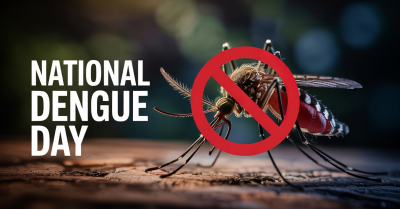
National Dengue Day is observed annually across India on 16 May to promote vector control awareness and preventive strategies prior to the onset of the southwest monsoon. Launched in 2010 by the Ministry of Health and Family Welfare, the initiative emphasizes localized containment and public responsibility to systematically reduce the transmission of the virus. Projections indicate a rising national disease burden, prompting calls for coordinated multi-sectoral action. The state-level flagship event for National Dengue Day 2026 was hosted in Goa at the Goa Shipyard Limited in Vasco, focusing on the latest dual-action awareness frameworks.
Etiology and Transmission Dynamics
The Pathogen and Serotypes
Dengue is a mosquito-borne viral disease caused by the dengue virus (DVD), which belongs to the Flaviviridae family. The virus exists as four distinct but closely related serotypes: DEN-1, DEN-2, DEN-3, and DEN-4. Infection with one serotype provides lifelong immunity against that specific serotype, but subsequent infections with other serotypes increase the risk of severe clinical complications.
Primary and Secondary Vectors
The virus transfers to humans through the bites of infected female mosquitoes.
- Aedes aegypti: The primary vector. It is a day-biting mosquito that thrives in urban and semi-urban environments, breeding predominantly in artificial containers containing clean, stagnant water.
- Aedes albopictus: The secondary vector. Known as the Asian tiger mosquito, it adapts well to rural, forested, and cooler temperate regions, expanding the geographic reach of the disease.
Clinical Manifestations and Pathology
Classical Dengue Fever
Symptoms manifest after an incubation period of 4 to 10 days following the mosquito bite. The disease presents as a severe, flu-like illness characterized by a sudden onset of high fever, intense headache, retro-orbital pain (pain behind the eyes), severe muscle and joint aches (breakbone fever), nausea, vomiting, and skin rashes.
Severe Dengue Syndromes
Without timely medical management, classical dengue can progress to life-threatening complications due to plasma leakage, fluid accumulation, respiratory distress, and severe organ impairment.
- Dengue Haemorrhagic Fever (DHF): Characterized by acute thrombocytopenia (a rapid drop in blood platelet counts), spontaneous bleeding from the gums or nose, and internal bleeding.
- Dengue Shock Syndrome (DSS): A critical progression where massive plasma leakage leads to cardiovascular collapse, dangerous drops in blood pressure, and hypovolemic shock.
Epidemiological Status and Institutional Framework
National Data Profiles
Provisional health reports compiled by the National Centre for Vector Borne Diseases Control (NCVBDC) highlight an active transmission window in early 2026.
| Parameter (As of February 2026) | National Metric / Distribution |
| Total Confirmed Cases | 6,927 cases |
| Total Reported Fatalities | 10 deaths |
| Highest State Case Burden | Tamil Nadu (2,873 cases) |
| Highest State Fatality Count | Kerala (9 deaths) |
| Secondary High-Burden States | Maharashtra (786 cases), Karnataka (560 cases), Andhra Pradesh (448 cases) |
| Historical Baseline (Full Year 2025) | 121,824 cases and 131 deaths nationwide |
| Long-Term Case Fatality Rate (CFR) | Maintained below 1 percent since 2008 (0.13 percent in 2024) |
Administrative Oversight
The National Centre for Vector Borne Diseases Control (NCVBDC) acts as the central nodal agency for formulating technical guidelines and monitoring trends. It administers operations through the National Vector Borne Disease Control Programme (NVBDCP) under the Ministry of Health and Family Welfare, tracking dengue alongside malaria, chikungunya, kala-azar, Japanese encephalitis, and lymphatic filariasis.
Prevention, Control, and Regulatory Challenges
Behavioral and Community Campaigns
The Ministry of Health and Family Welfare structures public outreach through dedicated annual taglines. The foundational baseline campaign uses the slogan “Unite. Act. Eliminate.” The specific operational theme designated for the 2026 mobilization cycle is “Community Participation for Dengue Control: Check, Clean and Cover.” This focuses on weekly source reduction, draining domestic water storage, and covering overhead tanks.
Vector Management and Chemical Interventions
Source reduction remains the most effective method of vector control. This involves eliminating larval habitats by draining flowerpots, air coolers, abandoned tires, and open drums. Chemical control involves using larvicides like Temephos in large water bodies and indoor residual spraying or space fogging during active outbreaks to eliminate adult mosquito populations.
Market Vulnerabilities in Personal Protection
Public health departments report concerns regarding the widespread availability of illegal, unapproved mosquito repellent products in commercial markets. These non-compliant formulations often bypass registration with the Central Insecticides Board and Registration Committee (CIB&RC), utilizing unlisted chemical concentrations that can pose respiratory risks to consumers while failing to provide reliable protection against vector bites.
IASPOINT Booster Facts for UPSC
- Global Burden: According to the World Health Organization (WHO), dengue is classified as the most prevalent and rapidly spreading vector-borne viral disease globally, putting more than 3.9 billion people across 132 countries at risk of infection.
- The Wolbachia Method: An advanced bio-control strategy involves introducing Wolbachia bacteria into Aedes aegypti populations. The bacteria compete with viruses like dengue, Zika, and chikungunya inside the mosquito, making it difficult for the virus to replicate and transmit to humans.
- Vaccine Landscape: The World Health Organization prequalified the Qdenga vaccine (TAK-003), a live-attenuated vaccine developed by Takeda Pharmaceuticals. For domestic deployment in India, manufacturing partnerships are underway with Hyderabad-based Biological E to align availability with the ‘Make in India’ framework, pending final approval from the National Technical Advisory Group on Immunization (NTAGI).
- Constitutional Division: Public health, sanitation, and hospitals fall under the State List (List II) of the Seventh Schedule of the Constitution of India, meaning state governments hold primary execution responsibility, while the central government provides financial and technical assistance.
- The Vector’s Biting Pattern: Aedes aegypti is characteristically known as a daylight feeder, with peak biting activity occurring early in the morning and late in the afternoon before dusk, distinguishing its management timeline from nocturnal Anopheles mosquitoes.