
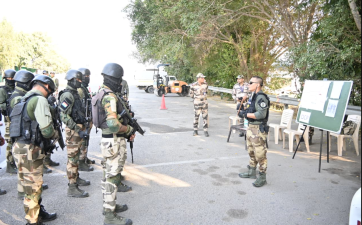
The Central Industrial Security Force (CISF) spearheaded a large-scale joint counter-terrorism mock exercise at New Delhi’s Indira Gandhi International (IGI) Airport to test emergency response frameworks and validate real-time crisis response mechanisms. Organised under the direct supervision of the Deputy Inspector General of Police (DIG) and Chief Airport Security Officer (CASO) of the Aviation Security Group (ASG) Delhi, the multi-agency security drill focused on building operational synergy against evolving threats to aviation security. Additionally, the CISF confirmed its comprehensive security deployment and passenger facilitation operationalization at the newly inaugurated Phase I of the Noida International Airport in Jewar, Uttar Pradesh.
Overview of the Joint Mock Exercise
The exercise was simulated to test the tactical preparedness of multiple security and civil aviation stakeholders under a unified command structure.
Participating Agencies
The drill brought together core central forces, state police, and aviation regulators to establish coordinated defence channels:
- Central Industrial Security Force (CISF): Involved specialized tactical wings including the Quick Reaction Team (QRT), Bomb Detection and Disposal Squad (BDDS), and K9 Dog Squad.
- National Security Guard (NSG): Provided elite counter-terror intervention support.
- Delhi Police: Managed outer perimeter security and local law enforcement coordination.
- Civil Aviation Regulators: Bureau of Civil Aviation Security (BCAS) and Directorate General of Civil Aviation (DGCA).
- Emergency & Logistics Support: Delhi Fire Service (DFS), Airport Rescue and Fire Fighting (ARFF) managed by Delhi International Airport Limited (DIAL), and dedicated medical response teams.
Key Objectives Evaluated
- Validation of Standard Operating Procedures (SOPs) for hostage scenarios, hijack threats, and dirty bomb discoveries.
- Assessment of inter-agency communication channels to eradicate response delays.
- Testing the swift mobilization of special tactical units during peak airport traffic hours.
Expanding Aviation Footprint: Noida International Airport
The expansion of CISF protection to the Noida International Airport (NIA) in Jewar marks a expansion of the critical infrastructure security grid in the Delhi-National Capital Region (NCR).
Deployment Specifications
- Induction Status: Noida International Airport is the 70th commercial airport in India to be integrated under the CISF security umbrella.
- Personnel Strength: The Ministry of Home Affairs sanctioned an initial deployment of 1,047 CISF personnel for Phase I operations.
- Command Structure: The security grid operates under the direct command of a designated Chief Aerodrome Security Officer (CASO).
- Core Responsibilities: The deployment covers perimeter wall security, access control points, anti-hijack screening, passenger baggage scanning, and terminal surveillance.
Features of Noida International Airport (Jewar)
The security infrastructure is aligned with the scale of this greenfield project:
| Feature | Details |
| Location | Jewar, Gautam Buddha Nagar district, Uttar Pradesh |
| Project Type | Greenfield Airport built on a Public-Private Partnership (PPP) model |
| Developer | Yamuna International Airport Private Limited (YIAPL), a subsidiary of Zurich Airport International AG |
| Codes Assigned | IATA Code: DXN |
| Capacity (Phase I) | 12 million passengers annually |
Institutional Framework of CISF
Understanding the administrative and operational structure of the CISF explains its mandate over national critical infrastructure.
Origin and Legal Mandate
- Establishment: Set up under the Central Industrial Security Force Act, 1968.
- Status: One of the seven Central Armed Police Forces (CAPFs) functioning under the Ministry of Home Affairs.
- Evolution: Originally created to protect government-owned industrial undertakings, the mandate was expanded via an amendment in 1999 to allow security provision to private sector industries and joint ventures on a cost-reimbursement basis.
Diversified Areas of Security Cover
The CISF does not just secure airports; its deployment spans across multiple sensitive sectors:
- Space and Nuclear Establishments: Department of Space (ISRO facilities) and Department of Atomic Energy (Bhabha Atomic Research Centre, nuclear power plants).
- Critical Infrastructure: Sea ports, Delhi Metro Rail Corporation (DMRC), coal mines, and oil refineries.
- Protected Monuments: Archeological Survey of India (ASI) sites including the Taj Mahal and Red Fort.
- VIP Security: Special Security Group (SSG) wing provides Z-plus, Z, X, and Y category protection to designated individuals.
IASPOINT Booster Facts for UPSC
- Aviation Security Regulatory Authority: The Bureau of Civil Aviation Security (BCAS) is the apex regulatory body for civil aviation security in India. It was initially set up as a cell in the DGCA in 1978 on the recommendation of the Pande Committee, following the hijacking of an Indian Airlines flight in 1976. It was reorganized into an independent department under the Ministry of Civil Aviation in 1987.
- The Regulatory Umbrella of DGCA: The Directorate General of Civil Aviation (DGCA) is the statutory body governing civil aviation safety, licensing, and airworthiness. It received statutory status under the Aircraft (Amendment) Act, 2020.
- First Private Sector Induction: The Infosys campus in Bengaluru became the first private sector establishment to receive CISF security cover following the 2009 amendment to the CISF Act.
- Financing Model: The CISF is a unique force because it operates on a cost-reimbursement model where the client organization, whether public or private, pays the central government for the deployment expenses of the personnel.