
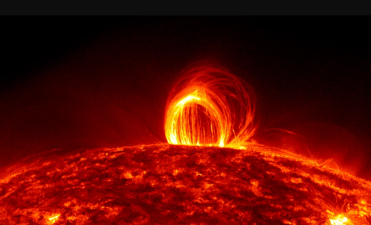
Researchers from the Aryabhatta Research Institute of Observational Sciences (ARIES) and the Indian Institute of Technology (IIT) Delhi have developed a diagnostic method using three-dimensional magnetohydrodynamic (MHD) simulations to identify hidden plasma turbulence in the solar corona. This computational advancement directly targets the long-standing coronal heating mystery—the phenomenon where the Sun’s outer atmosphere registers temperatures millions of degrees hotter than its underlying surface. Published in The Astrophysical Journal, the study demonstrates that transverse Alfvénic waves traveling through varying density structures generate localized phase mixing and wave-driven turbulence. This mechanism accounts for the extreme thermal energy of the corona without requiring large-scale plasma jets.
Mechanics of the Coronal Heating Paradox
Temperature Inversion Discrepancy
The solar interior generates energy through nuclear fusion, establishing a thermal gradient that cools outwardly through the convective zone. The visible surface of the Sun, known as the photosphere, maintains an effective temperature of approximately 5,500°C. In contrast, the corona, which extends millions of kilometers into space, exhibits temperatures ranging between 1,000,000°C and 3,000,000°C. Traditional thermodynamic laws dictate that heat should transfer from hotter regions to cooler ones, making the extreme temperature rise in the distant corona a fundamental paradox in solar physics.
Wave-Driven Turbulence vs. Plasma Flows
The research by ARIES and IIT Delhi isolates magnetohydrodynamic waves, specifically transverse Alfvénic waves, as the primary drivers of this heating. As these waves propagate through the magnetically confined loops of the corona, they interact with the uneven plasma densities. This interaction triggers a physical process called phase mixing, where adjacent magnetic field lines vibrate at slightly different frequencies, generating localized shear and small-scale turbulence.
Research Methodology and Key Findings
3D Magnetohydrodynamic (MHD) Simulations
The research team constructed 3D numerical models to simulate the behavior of magnetized plasma under coronal conditions. The simulations tracked how wave energy dissipates into thermal energy at microscopic scales. The mathematical framework combines fluid dynamics with Maxwell’s equations of electromagnetism to model plasma as a conductive fluid:
| Physical Parameter | Value/Range in Solar Corona | Impact on Heating |
| Plasma Temperature | 1 to 3 Million Kelvin | Dictates ionization states and emission lines. |
| Magnetic Field Strength | 1 to 10 Gauss (Active regions can exceed 100 G) | Channels Alfvén waves and traps coronal plasma. |
| Plasma Density | 108 to 109 particles per cm3 | Drives phase mixing due to spatial variations. |
| Alfvén Velocity | 1,000 to 2,000 km/s | Governs the propagation speed of magnetic waves. |
Correcting Spectral Line Misinterpretations
Prior spectroscopic observations regularly recorded asymmetric profiles in the extreme ultraviolet and X-ray emission lines of coronal plasma. Solar scientists historically interpreted these asymmetric lines as evidence of physical plasma flows or mass ejections traveling upward from the photosphere. The new 3D simulations prove that these exact asymmetric signatures are produced by line-of-sight velocity fluctuations caused by wave-driven turbulence. Consequently, the observed energy can be attributed to localized wave dissipation rather than large-scale plasma transport.
Validation and Observational Infrastructure
Space and Ground-Based Observatories
The diagnostic model developed by the Indian researchers provides specific spectral templates that can be verified by contemporary solar observation assets. The findings are being cross-referenced with high-resolution data from both ground telescopes and space missions to map the exact locations of the wave-driven turbulence.
Key Observational Platforms
- Daniel K. Inouye Solar Telescope (DKIST): Located in Hawaii, USA, this is the world’s largest ground-based solar telescope. Its 4-meter aperture allows it to resolve magnetic structures in the solar atmosphere down to 20 kilometers, providing the high-resolution polarimetric and spectroscopic data needed to test the ARIES-IIT Delhi model.
- Aditya-L1 Mission: India’s first dedicated space-based solar observatory, positioned at the Lagrangian Point 1. Its payloads, particularly the Visible Emission Line Coronagraph (VELC), monitor the dynamics and spectral emissions of the solar corona.
- Parker Solar Probe: A NASA spacecraft executing close flybys of the Sun, entering the outer corona to take direct in-situ measurements of magnetic fields, plasma density, and wave behavior.
IASPOINT Booster Facts for UPSC
- The Photosphere-Chromosphere-Corona Hierarchy: The Sun’s atmosphere consists of the photosphere (lowest layer, ~5,500°C), the chromosphere (middle layer, ~6,000°C to 20,000°C), the transition region (where temperature surges abruptly), and the corona (outermost layer, exceeding 1,000,000°C).
- Alfvén Waves Defined: Named after Hannes Alfvén (who won the 1970 Nobel Prize in Physics), these are low-frequency traveling oscillations of ions and magnetic fields in a plasma. Unlike sound waves, Alfvén waves are transverse and travel along magnetic field lines.
- The Role of ARIES: The Aryabhatta Research Institute of Observational Sciences is an autonomous research institute under the Department of Science and Technology (DST), Government of India, located in Nainital, Uttarakhand.
- Nanoflares Alternative Theory: Apart from wave heating (Alfvénic induction), the other major competing theory for coronal heating is the “nanoflare” hypothesis proposed by Eugene Parker. It suggests millions of continuous, small-scale magnetic reconnection events explode across the solar surface, releasing energy into the corona.
- First Discovery of the Corona’s Heat: The extreme temperature of the corona was first recognized in 1939 by Bengt Edlén and Walter Grotrian, who identified strange green and iron emission lines (like Fe XIV) that could only exist if iron atoms had lost 13 of their electrons, an ionization state requiring million-degree temperatures.