
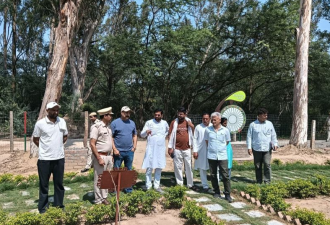
The Haryana Sarasvati Heritage Development Board (HSHDB) has developed the state’s first constellation garden, named ‘Nakshatra Vatika’, at the Saraswati Wildlife Sanctuary in Pehowa. Inaugurated during the state’s Van Mahotsav celebrations, the garden features tree species specifically associated with the 27 lunar mansions (nakshatras) of ancient Indian tradition. The initiative blends ecological conservation with cultural heritage to educate younger generations about traditional forestry and biodiversity. Alongside the garden, the state government is introducing new eco-tourism initiatives, including a proposed semi-safari within the sanctuary.
Geographic and Administrative Profile
Saraswati Wildlife Sanctuary
The sanctuary is located in the Kurukshetra and Kaithal districts of Haryana. It spans an area of over 4,400 hectares, making it one of the largest forest tracts in the state. Historically, the area was known as Seonsar Forest. The region is widely believed to lie along the ancient paleo-channels of the Sarasvati River network.
Haryana Sarasvati Heritage Development Board
The HSHDB is a specialized state body tasked with researching, restoring, and preserving the heritage of the ancient Sarasvati River. The board handles the rejuvenation of channels, groundwater recharging along the riverbed, and the promotion of eco-tourism corridors associated with the river’s historical path.
Botanical and Astrological Configuration of Nakshatra Vatika
The Concept of Constellation Gardens
A Nakshatra Vatika is a traditional landscaping model where specific trees are planted to correspond with the 27 nakshatras (constellations) of Vedic astronomy. Each constellation is assigned a specific patron tree based on traditional ecological knowledge. Visitors can locate and study the tree tied to their birth constellation, fostering personal connections to forest conservation.
Tree Matrix for the 27 Nakshatras
The garden features a curated layout of 27 distinct plant species, each carrying specific ecological, medicinal, and cultural importance:
| Nakshatra (Constellation) | Associated Tree (Common Name) | Scientific Name | Key Ecological / Medicinal Use |
| Ashwini | Kuchila / Strychnine Tree | Strychnos nux-vomica | Contains alkaloids used in nervous system treatments. |
| Bharani | Amla / Indian Gooseberry | Phyllanthus emblica | Rich in Vitamin C; core ingredient in Ayurvedic formulations. |
| Krittika | Gular / Cluster Fig | Ficus racemosa | Keystone species providing food for forest birds and primates. |
| Rohini | Jamun / Java Plum | Synergium cumini | Seeds help regulate blood sugar levels in traditional medicine. |
| Mrigashira | Khair / Cutch Tree | Senegalia catechu | Provides tannin and acts as a nitrogen-fixing forest tree. |
| Ardra | Agarwood / Krishna Agar | Aquilaria malaccensis | Highly valued for aromatic resin production. |
| Punarvasu | Bamboo | Bambusa vulgaris | Fast-growing grass essential for soil stabilization. |
| Pushya | Pipal / Sacred Fig | Ficus religiosa | High oxygen-release rate; supports massive insect and avian life. |
| Ashlesha | Nagkesar / Ceylon Ironwood | Mesua ferrea | Wood is extremely hard; flowers used in cosmetics and oils. |
| Magha | Bar / Banyan | Ficus benghalensis | National tree of India; creates sprawling canopy ecosystems. |
| Poorva Phalguni | Palas / Flame of the Forest | Butea monosperma | Host tree for lac insects; natural dye source. |
| Uttara Phalguni | Pakar / White Fig | Ficus virens | Large shade-giving tree that controls soil erosion. |
| Hasta | Jaiphal / Wild Date Palm | Phoenix sylvestris | Edible fruit source; leaves used for traditional weaving. |
| Chitra | Bel / Bengal Quince | Aegle marmelos | Drought-resistant tree; fruit cures digestive disorders. |
| Swati | Arjun | Terminalia arjuna | Bark is used to manufacture cardiac medicines. |
| Visakha | Vikankat / Governor’s Plum | Flacourtia indica | Thorny shrub providing habitat for small nesting birds. |
| Anuradha | Moulshree / Spanish Cherry | Mimusops elengi | Fragrant flowers; dense canopy helps mitigate urban noise. |
| Jyeshtha | Semal / Silk Cotton Tree | Bombax ceiba | Large red flowers attract pollinators; wood used for light matchsticks. |
| Moola | Salai / Indian Frankincense | Boswellia serrata | Yields oleo-gum-resin used for anti-inflammatory treatments. |
| Poorva Ashadha | Gular / Fish-poison Tree | Barringtonia acutangula | Thrives in marshy terrain; stabilizes wet soils. |
| Uttara Ashadha | Kathal / Jackfruit | Artocarpus heterophyllus | Yields largest tree-borne fruit; high nutritional profile. |
| Shravana | Akarkara / Swallow-wort | Calotropis gigantea | Host plant for Monarch butterflies; thrives in arid soil. |
| Dhanishta | Shami / Indian Mesquite | Prosopis cineraria | State tree of Rajasthan; survives extreme drought conditions. |
| Shatabhisha | Kadamb | Neolamarckia cadamba | Rapidly growing pioneer species used in agroforestry. |
| Poorva Bhadrapada | Mango | Mangifera indica | Major tropical fruit crop; high carbon sequestration potential. |
| Uttara Bhadrapada | Neem | Azadirachta indica | Natural biopesticide and antibacterial agent. |
| Revati | Mahua / Butter Tree | Madhuca longifolia | Seeds yield oil; flowers are a source of bioethanol. |
Ecological and Tourism Initiatives
Semi-Safari Development
The Haryana government is planning to partition a segment of the Saraswati Wildlife Sanctuary to establish a semi-safari. This initiative will allow regulated tourist vehicles to enter designated tracks, boosting local eco-tourism revenues. The infrastructure will be designed to prevent fragmentation of the core wildlife habitat.
Biodiversity Retention
The sanctuary harbors distinct wildlife populations, including blue bulls (nilgai), wild boars, rhesus macaques, spotted deer, and jackals. It also acts as a winter refuge for migratory waterbirds due to its network of small seasonal wetlands and proximity to the modified Sarasvati drainage channels.
IASPOINT Booster Facts for UPSC
- Navagraha and Rashi Vatikas: Similar to Nakshatra Vatikas, Indian traditional forestry includes Navagraha Vatikas (nine plants representing the nine celestial bodies) and Rashi Vatikas (twelve plants representing the zodiac signs). These concepts are studied under ethno-botany.
- Ancient Paleochannel Research: The Indian Space Research Organisation (ISRO) and the Central Ground Water Board (CGWB) have conducted extensive satellite imagery studies validating the presence of buried paleochannels in Haryana and Rajasthan, closely matching the described path of the Sarasvati River.
- Van Mahotsav Origin: This annual pan-Indian tree-planting festival was initiated in 1950 by Kanaiyalal Maneklal Munshi, the then Union Minister for Food and Agriculture, to create enthusiasm among citizens for forest preservation.
- Legal Status of Sanctuary: The Saraswati Wildlife Sanctuary was officially notified under the provisions of the Wildlife (Protection) Act, 1972. This designation places legal restrictions on industrial activities, logging, and hunting within its boundaries.
- Keystone Species Dominance: The presence of multiple Ficus species (Pipal, Banyan, Gular) in the Nakshatra Vatika establishes a perennial food supply for regional frugivores (fruit-eating animals). Ficus is classified as a structural keystone genus because it fruits during seasons when other forest trees face scarcity.