
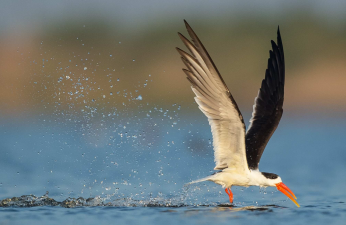
The endangered Indian Skimmer bird has been sighted after nearly 20 years along a 60-kilometer stretch of the Ganga River within the Vikramshila Gangetic Dolphin Sanctuary in Bihar’s Bhagalpur district. Known for its distinct foraging mechanism and unequal bill length, the species serves as an indicator of clean, healthy freshwater environments with stable fish populations. The return of the birds to this region reflects an improvement in the water quality and ecological health of the Ganga River. This development marks a milestone for river ecosystem restoration managed under the National Mission for Clean Ganga.
Morphological and Behavioral Profile
Distinctive Anatomy
The Indian Skimmer (Scientific name: Rynchops albicollis), also known as the Indian scissors-bill, belongs to the skimmer genus Rynchops within the family Laridae. The bird is recognized by its black upper body, pure white underbelly, and a bright orange-yellow bill. Its defining physical feature is its unequal bill structure, where the lower mandible is elongated and much longer than the upper mandible.
Foraging Technique
The specialized beak structure dictates the bird’s feeding behavior. The Indian Skimmer flies very low over the water surface with its mouth open, keeping its elongated lower mandible submerged in the water. As it skims the surface, the lower beak snaps shut immediately upon making physical contact with small fish, aquatic insects, or crustaceans. This method allows the bird to feed effectively in low-light conditions, making it a largely crepuscular (active during dawn and dusk) and nocturnal hunter.
Breeding and Nesting Ecology
The species is a habitat specialist that breeds during the summer season from March to June. This timeline coincides with low river water levels, which leads to the emergence of mid-river sandbars and temporary sandy islands. The birds nest colonially on these bare, isolated sandbars, which naturally protects their eggs from land-based predators. They frequently share these nesting sandbars with other riverine species, including River Terns, Black-bellied Terns, and River Lapwings.
Distribution and Conservation Status
Geographic Range
The Indian Skimmer is native to South Asia. While it historically occupied wide river networks across the Indian Subcontinent and Southeast Asia, its distribution has contracted heavily. It is considered extinct in Cambodia, Laos, and Vietnam. At present, the global population is almost entirely restricted to India, Pakistan, and Bangladesh, with minor, sporadic occurrences recorded in Nepal and Myanmar.
Distribution Matrix in India
The species relies on specific large, lowland rivers and coastal sites across India during different life stages:
| Region / River Basin | State | Ecological Status / Role |
| National Chambal Sanctuary | Madhya Pradesh, Rajasthan, Uttar Pradesh | The largest remaining global breeding stronghold for the species. |
| Mahanadi River Basin | Odisha | A primary active breeding site utilizing seasonal sandbars. |
| Coringa Wildlife Sanctuary | Andhra Pradesh | Major wintering and foraging ground during the non-breeding season. |
| Vikramshila Gangetic Dolphin Sanctuary | Bihar | Historical habitat showing recent nesting and sighting revival. |
| Coastal Jamnagar & Kakinada | Gujarat & Andhra Pradesh | Marine estuaries used by flocks for non-breeding winter migration. |
Protection and Conservation Status
The global population of mature Indian Skimmers is estimated to be under 3,000 individuals, showing a sharp drop over the past two decades. Its formal protection classifications include:
- IUCN Red List: Endangered (Uplisted from Vulnerable due to a 40% population drop).
- CITES: Not currently listed on the core appendices, but tracked via regional conservation frameworks.
- State of India’s Birds Report: Categorized as a species “Of High Conservation Concern.”
Threats to Survival and Conservation Initiatives
Primary Ecological Threats
The survival of the Indian Skimmer is tied to the dynamics of unobstructed river systems. Major threats include:
- Hydrological Disturbances: Unplanned water releases from upstream dams flood mid-river sandbars during the peak breeding season, washing away active nests and eggs. Conversely, excessive water extraction lowers river levels too much.
- Predation and Trampling: When water levels drop excessively, sandy islands connect to the riverbanks. This allows domestic cattle, feral dogs, and jackals to access the colonies, leading to the trampling and predation of chicks.
- Anthropogenic Exploitation: Illegal sand mining destroys the specific sandbar topography required for nesting. Seasonal riverbed agriculture, such as cucurbit (melon and gourd) cultivation on exposed sandbars, further restricts the birds’ nesting territory.
Institutional Conservation Efforts
To stabilize the declining population, targeted conservation programs have been introduced:
- NMCG-BNHS Collaboration: The National Mission for Clean Ganga partnered with the Bombay Natural History Society to implement a dedicated conservation project for riverine birds across the Ganga Basin.
- Community-Based “Guardians of the Skimmer”: Local youth and fishermen are trained to monitor nesting sites, protect vulnerable sandbars from cattle entry, and minimize human disturbance during the breeding months.
- Indian Skimmer Count: A structured citizen-science initiative conducted in multiple phases to map seasonal distribution and count wintering flocks across South Asian wetlands.
IASPOINT Booster Facts for UPSC
- Indicator Species: The Indian Skimmer is a key bio-indicator of riverine health. Its presence confirms low chemical pollution, minimal siltation, and an intact aquatic food chain capable of supporting specialized apex predators.
- Whitley Award Recognition: In 2026, Indian biologist Parveen Shaikh received the prestigious Whitley Award (often called the “Green Oscar”) for her community-led efforts to protect Indian Skimmer nesting colonies in the National Chambal Sanctuary.
- Belly-Soaking Behavior: To protect eggs from extreme summer heat on open sandbars, adult Indian Skimmers perform “belly-soaking.” They fly low to wet their abdominal feathers in the river before returning to sit on the nest, cooling the eggs through evaporation.
- Vikramshila Sanctuary Profile: Established under the Wildlife (Protection) Act, 1972, the Vikramshila Gangetic Dolphin Sanctuary is the only protected area designated specifically for the endangered Gangetic Dolphin (Platanista gangetica) in India, stretching along a 50-kilometer segment of the Ganga River.
- Natal and Site Fidelity: Banding and color-flagging studies by the Bombay Natural History Society show that Indian Skimmers exhibit high site fidelity. Adults return to the exact same sandbars to breed year after year, while chicks display natal fidelity by returning to their birthplace once they mature.