
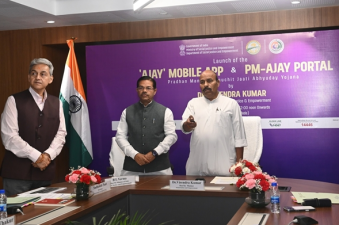
The Ministry of Social Justice and Empowerment (MoSJE) has officially launched the centralized PM-AJAY portal and the integrated AJAY mobile application. This digital governance initiative transitions the implementation framework of the Pradhan Mantri Anusuchit Jaati Abhyuday Yojna (PM-AJAY) from legacy paper-based processing to an end-to-end digital workflow. Designed to advance the inclusive development mandate of the Viksit Bharat mission, the platform provides real-time monitoring, milestone-linked fund flows, and field-level coordination across more than 47,000 Scheduled Caste (SC) majority villages, tracking development delivery for over four million targeted beneficiaries.
Core Capabilities of the Digital Platform
Architecture of the PM-AJAY Portal
The central portal acts as the programmatic command center for the scheme, handling data aggregation and algorithmic financial management. It replaces manual verification with an automated, milestone-linked tracking framework that triggers fiscal releases as soon as local administrative bodies digitally clear project parameters.
Functionality of the AJAY Mobile Application
The mobile application extends portal utility directly to field functionaries to assist with grassroots execution. It operates with role-based access controls and a unified login structure, enabling on-ground administrators to capture data, register individuals, and process local approvals from a single mobile interface.
Technical Features of the Field App
The application contains specialized modules to support field deployment under variable connectivity conditions:
- Offline Data Capture: Field teams can conduct door-to-door socio-economic surveys and upload datasets once internet connectivity is restored.
- Real-time VDP Generation: The app processes local survey inputs to generate instant Village Development Plans (VDPs) directly on site.
- Geo-Tagged Verification: Project inspection officers use the app to upload time-stamped, geo-tagged photographs from construction sites to verify physical development milestones before funds are transferred.
Component-Wise Integrated Monitoring
The digital framework consolidates three independent programmatic verticals into a unified monitoring dashboard to track distinct development goals.
| Component Under PM-AJAY | Specific Technical Integration | Core Tracking Metric |
| Adarsh Gram | Migrates operations from the old PMAGY portal to the new dynamic interface. | Monitors model village creation across 50 indicators within 10 development domains. |
| Grants-in-Aid (GIA) | Functions as a centralized Management Information System (MIS) for state-wide data. | Tracks financial outlays, beneficiary mapping, and skill training completions for livelihoods. |
| Hostel Infrastructure | Dedicated platform for infrastructure tracking. | Records the continuous physical and financial progress of new hostel construction and repairs. |
Structural Metrics of the Adarsh Gram Component
Monitorable Domains
The Adarsh Gram module tracks village saturation against 50 distinct socio-economic indicators divided across 10 developmental sectors. These sectors cover critical rural requirements:
- Drinking water and sanitation
- Education and financial inclusion
- Health and nutrition
- Social security and digitization
- Rural roads and housing
- Electricity and clean fuel access
- Improved agricultural practices
Eligibility Thresholds for Village Selection
The system applies specific demographic and operational filters to determine village entry into the Adarsh Gram network:
- Population Floor: The village must have a total population of at least 500 residents.
- Demographic Composition: Scheduled Caste individuals must constitute a minimum of 40% of the local population.
- Governance Assurances: Local bodies must formally establish a Village Level Convergence Committee and pledge participation in inter-schematic convergence.
Structural Background of PM-AJAY
Scheme Consolidation
PM-AJAY was introduced during FY 2021-22 as a 100% centrally funded scheme under the Ministry of Social Justice and Empowerment. It was created by merging three separate erstwhile Centrally Sponsored Schemes:
- Pradhan Mantri Adarsh Gram Yojana (PMAGY)
- Special Central Assistance to Scheduled Castes Sub Plan (SCA to SCSP)
- Babu Jagjivan Ram Chhatrawas Yojana (BJRCY)
Programmatic Objectives
The unified scheme aims to address multi-dimensional poverty within SC communities through three distinct tracks. First, it focuses on reducing income deficits by providing financial subsidies and skill development training for self-employment. Second, it enhances village-level infrastructure to bridge critical development gaps in SC-dominated areas. Third, it builds student hostels in high-ranking national institutions and schools to improve literacy rates and educational retention.
IASPOINT Booster Facts for UPSC
- Financial Subsidies: Under the Income Generating component of the scheme, eligible beneficiaries receive a financial subsidy up to ₹50,000 or 50% of the total project loan amount, whichever is less.
- Institutional Custody: The technical design, database architecture, and software maintenance of the portal are handled by the National Informatics Centre (NIC) in coordination with the Project Implementation Unit (PIU) of the MoSJE.
- Administrative Fund Cap: Up to 5% of the total annual budgetary allocation of the PM-AJAY scheme is set aside for administrative, monitoring, evaluation, and social audit expenses.
- Hostel Selection Rules: Hostel construction under the scheme is directed toward top-ranked schools and higher educational institutions designated under the National Institutional Ranking Framework (NIRF).
- Demographic Context: According to data from the 2011 Census of India, Scheduled Castes comprise 16.6% of the country’s total population, forming the core target demographic for these consolidated interventions.