
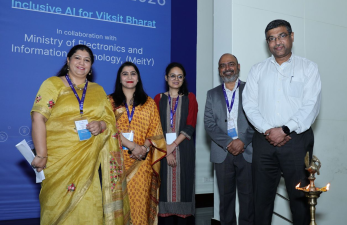
The Ministry of Electronics and Information Technology (MeitY), in collaboration with the Bharti Institute of Public Policy at the Indian School of Business (ISB), hosted the Governance Summit 2026 on May 23, 2026, at the ISB Mohali campus. Centered on the theme “Inclusive AI for Viksit Bharat,” the fourth edition of this day-long national summit focused on advancing AI-powered solutions to drive socio-economic growth. The event brought together over 250 delegates, including senior central and state government officials, industry leaders, academics, and civil society representatives to build balanced frameworks that ensure equitable technology access across India.
Core Pillars of Discussion
The summit structured its agenda around four thematic panel tracks and a dedicated institutional roundtable to address technological opportunities and human resource protections.
Thematic Panel Focus Areas
- Digital Commerce: Evaluating how AI-driven local marketplace ecosystems can enhance productivity for small businesses, rural entrepreneurs, and localized supply chains.
- Online Safety: Formulating protective algorithms and safety mechanisms specifically designed to protect women and children from emerging cyber threats, deepfakes, and algorithmic bias.
- Healthcare Access and Affordability: Deploying predictive diagnostics, remote telemedicine infrastructure, and unified digital health records to lower service costs in underserved rural regions.
- Workforce Transformation: Addressing concerns regarding the automation of cognitive tasks while examining paths for youth upskilling, job creation, and digital entrepreneurship in technology-enabled services.
Last-Mile Public Service Delivery
A dedicated administrative roundtable focused on the operationalization of localized AI. Discussions centered on creating functional channels to transition technology applications from central data repositories down to state administrations and grassroots gram panchayats. The primary objective is establishing affirmative action policies and social security protections that prevent technology from worsening existing income or access inequalities.
Key Sectoral Applications of Inclusive AI
The summit highlighted how targeted deployment of artificial intelligence serves as a direct intervention mechanism across major public and economic sectors.
| Sector | Specific AI Deployment | Target Outcome |
| Healthcare | Predictive diagnostic tools and automated triaging. | Early disease detection and reduced patient load at primary health centers. |
| Education | Personalized adaptive learning portals in native languages. | Lowering school dropout rates and expanding regional language literacy. |
| Agriculture | Computer vision for crop pest analysis and predictive weather modeling. | Minimizing crop losses and optimizing inputs for smallholder farmers. |
| Financial Services | Alternative AI-based credit scoring models. | Extending micro-loans and formal credit lines to unbanked populations. |
| Public Governance | Automated multilingual grievance routing systems. | Fast-tracking public service resolution times at the municipal block level. |
Participating Organizations and Ecosystem Stakeholders
The intersection of state policy, corporate technology, and civil society was represented by active participation from diverse entities:
- Government Ministries: Representatives from multiple central and state administrative departments, including the Punjab Police, who deliberated on safety and enforcement algorithms.
- Industry Leaders: Major corporate stakeholders including Reliance Retail, Mastercard, and Apollo Hospitals contributing commercial deployment perspectives.
- Academic and Civil Bodies: Technological and social inputs provided by institutions such as the Indian Institute of Technology (IIT) Madras and UNICEF India.
IASPOINT Booster Facts for UPSC
- Viksit Bharat Vision: This represents the formal government strategy to transform India into a fully developed nation by the year 2047, marking 100 years of independence.
- IndiaAI Mission: Approved with a financial outlay of over 10,300 crore rupees, this central initiative establishes India’s computing infrastructure, including an AI supercomputing marketplace, native large language models (LLMs), and dedicated research centers.
- Global Partnership on Artificial Intelligence (GPAI): India is a founding member of GPAI, an international initiative established in 2020 to guide the responsible development and utilization of AI, grounded in human rights, inclusion, and economic growth.
- MeitY AI Governance Panel: In April 2026, the central government constituted a high-level AI governance panel led by Union Minister Ashwini Vaishnaw to formulate comprehensive regulatory frameworks for emerging intelligence systems.
- Bharti Institute of Public Policy (BIPP): Operating as an independent research institute within the Indian School of Business (ISB), BIPP focuses on training, data analysis, and policy formulation across public systems, agriculture, and digital governance.