
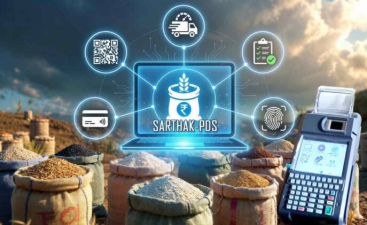
The Cabinet Committee on Economic Affairs (CCEA), chaired by Prime Minister Narendra Modi, approved the extension and restructuring of the public distribution ecosystem through the “Scheme for Assistance in Ration Transport and Handling-Income with Automation in PDS” (SARTHAK-PDS). Operating as an umbrella scheme during the 16th Finance Commission cycle from April 2026 to March 2031, the project carries a central financial outlay of Rs 25,530 crore. The initiative aims to streamline the supply chain, increase remuneration for Fair Price Shop dealers, and deploy artificial intelligence to eliminate leakages, securing welfare delivery for 81.35 crore beneficiaries under the National Food Security Act, 2013.
Structural Architecture and Integration
Convergence of Legacy Programs
The SARTHAK-PDS scheme unifies two previously separate central sector initiatives into a single administrative framework to manage the foodgrain value chain.
- Component A: Assistance to State Agencies for intra-State movement of foodgrains and Fair Price Shop (FPS) dealers’ margins under the National Food Security Act (NFSA).
- Component B: Scheme for Modernization and Reforms through Technology in Public Distribution System (SMART-PDS).
Strategic Objectives
- Logistics Optimization: Direct financial assistance to States and Union Territories to manage the cost of transporting food grains from Food Corporation of India (FCI) base depots to regional border points and retail shops.
- Dealer Sustainability: Revisions in dealer margins to ensure the financial viability of local fair price shops, incentivizing clean operations and accurate weighing.
- Leakage Erasure: Elimination of zero-value or duplicate cards via algorithmic cross-checks, preventing grain diversion to open markets.
The Tech Stack: AI, Blockchain, and Automation
Three Pillars of Digital Oversight
The modernization architecture depends on three newly introduced, specialized artificial intelligence and machine learning platforms that handle distinct segments of the distribution process.
NIRMAL (AI Beneficiary Registry)
- Serves as a real-time, self-cleaning beneficiary database.
- Employs automated matching tools to continuously identify, flag, and remove duplicate, dead, or ghost beneficiaries across inter-state boundaries.
- Integrates with dynamic socio-economic registries to automate card inclusion and exclusion criteria based on verified economic changes.
SAKSHAM (Intelligent Supply Chain Platform)
- Manages predictive logistics, using machine learning to forecast grain requirements based on historical consumption data at individual retail outlets.
- Implements mandatory GPS-enabled vehicle tracking for all state-contracted food grain transport trucks.
- Uses automated route optimization models to minimize transport mileage. The government projects a 15% to 50% reduction in overall PDS logistics costs, an annual administrative saving of Rs 280 crore, and a 36% drop in associated transport carbon emissions.
ASHA (Multilingual Grievance Assistant)
- Operates as a public-facing, natural language processing conversational engine available in scheduled Indian languages.
- Accepts direct inputs, text voice notes, and photographic evidence of poor ration quality or short-weighing from citizens.
- Automatically routes specific complaints to district grievance redressal officers with fixed timelines for legal closure.
Core Integrity Technologies
- Blockchain Ledger System: Used to secure digital distribution ledgers, ensuring entry transactions at storage depots match weight receipts generated at the final point of sale without data tampering.
- QR-Coded Grain Bags: Implements unique cryptographic QR tags sewn onto institutional gunny sacks to ensure end-to-end trace history from public silos to retail shops.
- State Command and Control Centres: Centralized data hubs set up across state capitals to provide live visibility over point-of-sale machines, inventory levels, and real-time weighments.
- ISO-Certified Operational Frameworks: Standardizes the physical handling, storage conditions, and safety auditing parameters across all public distribution warehouses.
Operational Hierarchy of the PDS Value Chain
| Process Stage | Modernized Action Under SARTHAK-PDS | Institutional Safeguard |
| Beneficiary Verification | Registry updating using the NIRMAL system. | Aadhaar-seeded biometric checks at point of sale. |
| Logistics & Transport | SAKSHAM path planning and vehicle tracking. | QR-coded identification on individual crop bags. |
| Retail Distribution | Upgraded financial compensation for retail dealers. | Mandatory electronic weighing scale integration. |
| Public Grievances | Instant automated filing using the ASHA assistant. | Direct administrative monitoring by State Control Centres. |
IASPOINT Booster Facts for UPSC
- Constitutional Allocation: The Public Distribution System operates under a joint mandate. The Central Government holds exclusive responsibility for procurement, international imports, buffer storage, and inter-state transport of grain through the Food Corporation of India. State Governments hold the administrative duty to identify local beneficiaries, issue legal ration documents, allocate licenses, and supervise local Fair Price Shops.
- Legislative Framework: The National Food Security Act, 2013, provides statutory legal backing to the distribution network, converting welfare benefits into legal rights. It covers up to 75% of the rural population and up to 50% of the urban population under priority households and Antyodaya Anna Yojana.
- E-PoS Scale Convergence: Under the rules, all Electronic Point of Sale devices must physically link with electronic weighing scales. A transaction receipt will only generate when the recorded biometric matches the exact mass weight of the grain distributed.
- Linkage with PM-GKAY: The infrastructure upgraded by SARTHAK-PDS will directly support the field distribution of the Pradhan Mantri Garib Kalyan Anna Yojana, which supplies free food grains to eligible households.
- Historical Evolution Track: The Indian public distribution mechanism evolved from a universal rationing scheme introduced during World War II into the Revamped Public Distribution System (1992), transitioned into the Targeted Public Distribution System (1997), and was later digitized via the Integrated Management of Public Distribution System (IM-PDS) which enabled the One Nation One Ration Card framework.