
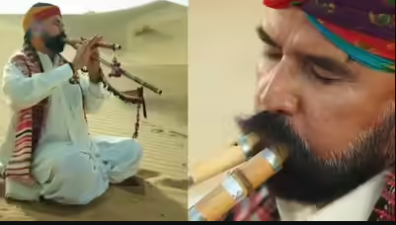
President Droupadi Murmu awarded the Padma Shri 2026 to Rajasthan’s folk artist Taga Ram Bheel for his exceptional contribution to preserving and promoting the Algoza, a traditional double-flute wind instrument native to the Thar Desert. The Algoza is a challenging instrument that embodies the cultural heritage of Rajasthan and surrounding regions, known for its unique sound created by playing two wooden pipes simultaneously using circular breathing. Taga Ram Bheel, a master craftsman and performer from Jaisalmer, has popularized this endangered musical tradition nationally and internationally through performances in over 35 countries. His recognition highlights the importance of conserving India’s indigenous art forms and folk music heritage.
Organology and Technical Mechanics
Structural Composition
The Algoza belongs to the woodwind family of musical instruments, classified under the Hornbostel-Sachs system as a flute with internal duct or beak flutes. It consists of two coupled hollow pipes of equal or slightly varying lengths, traditionally crafted from bamboo, wood, or reeds. The two pipes are either bound together firmly with strings or held loosely side-by-side in the performer’s hands. Each pipe features up to five or six finger holes, and the musician utilizes three fingers on each side to manipulate the sound holes.
Acoustic Dualism
The acoustic framework relies on a system where the two pipes perform distinct sonic roles simultaneously:
- The Melody Pipe: One flute is designated to play the central musical notes and changing melodies.
- The Drone Pipe: The second flute provides a continuous, unchanging background note or drone that anchors the performance.
The Metaphor of Gender
In traditional desert folklore and instrumental terminology, the twin pipes are viewed as a couple. The longer pipe represents the male sound, while the shorter or altered pipe represents the female sound. Musicians frequently use natural beeswax to seal certain holes or adjust the internal airflow, allowing them to scale and tune the instrument to different musical pitches.
Playing Technique and Performance Dynamics
Circular Breathing Method
Mastering the Algoza demands high physical control due to the mandatory use of circular breathing. This technique requires the artist to inhale continuously through the nose while simultaneously exhaling air stored in the cheeks into the instrument. This continuous air stream ensures that the musical notes never break, allowing for long, uninterrupted recitatives.
Bouncing Rhythm
The quick recapturing of breath on every musical beat creates a distinctive bouncing, swinging rhythm. This rapid breathing cycle provides both a melodic composition and a built-in percussive texture, eliminating the absolute necessity of a separate accompanying drum.
Cultural Distribution and Social Context
Regional Spread
The instrument is prominent across the northwestern part of the Indian subcontinent. It is central to the folk music traditions of:
- Rajasthan (particularly the desert districts of Jaisalmer, Barmer, Tonk, and Ajmer)
- Punjab
- Gujarat (Kutch region)
- Sindh and Balochistan
Associated Communities
In Rajasthan, the Algoza is primarily played by the pastoral and tribal communities. The shepherd communities use it during grazing, while traditional musical and dance groups like the Bhil and Kalbelia communities integrate it into ritualistic and celebratory folk performances.
Classification of Rajasthani Musical Instruments
To understand the place of the Algoza in traditional music, it is useful to view it alongside other major indigenous instruments of the region across different structural categories.
| Instrument Category | Structural Description | Prominent Examples in Rajasthan |
| Sushira Vadya | Wind instruments requiring air vibration | Algoza, Pungi, Satara, Mashak (Bin), Murli |
| Tata Vadya | Stringed instruments played with bows or plucking | Kamayacha, Ravanhatta, Jantar, Chautara, Bhapang |
| Avanaddha Vadya | Percussion instruments with membrane drumheads | Deru, Nagada, Chang, Khanjari |
| Ghana Vadya | Solid instruments producing resonant sound without membranes | Khartal, Manjira, Thali |
IASPOINT Booster Facts for UPSC
- Historical Roots: The origins of the double flute trace back to ancient Mesopotamia around 7500 BC, appearing in archaic paintings as “Al-Joza” (meaning the twin) before traveling to Iran and the Indian subcontinent.
- Padma Recognition: Taga Ram Bheel joined the ranks of legendary folk preservationists like Sakar Khan (Kamayacha maestro) who received national civilian honors for keeping desert instruments alive.
- Sushira Vadya Context: The Pungi, another Rajasthani wind instrument made of bamboo and a gourd, shares the circular breathing technique with the Algoza and was historically played by snake charmers.
- The Kamayacha Contrast: While the Algoza represents the wind tradition, the 17-stringed Kamayacha represents the bow-string tradition of Jaisalmer, made from a single piece of mango wood and goat leather.
- Thar Desert Eco-Musicology: Many folk instruments of Rajasthan utilize local natural materials, such as dried gourd shells for the Bhapang and Pungi, or local desert wood for the Algoza, establishing a direct link between ecology and culture.