
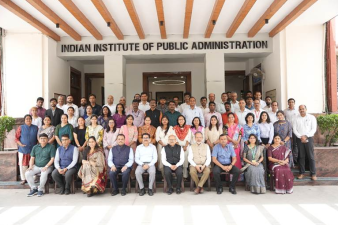
The Ministry of Panchayati Raj recently organized a three-day Training of Trainers programme under its newly launched Nirbhay Raho initiative. Funded through the national Nirbhaya Fund, this capacity-building exercise focuses on educating Elected Women Representatives about statutory legal provisions, gender sensitivity, and grassroots institutional response mechanisms for women’s safety. The training session brought together approximately 50 master trainers from various state-level rural development institutions. Ultimately, the Nirbhay Raho initiative aims to empower nearly 32 lakh elected panchayat representatives across India to build gender-responsive local governance and establish community-led safety networks in rural areas.
Three-Pillar Architecture of Nirbhay Raho
The initiative functions through three dedicated structural interventions designed to address rural women’s safety from legislative, behavioral, and infrastructural perspectives.
Nirbhay Netri
This pillar targets the capacity building of Elected Women Representatives at all three tiers of the Panchayati Raj system. It trains them on legal rights, specific provisions of the Bharatiya Nyaya Sanhita, and mechanism channels like the Protection of Women from Domestic Violence Act. The training empowers these leaders to act as first-responders and legal guides for women facing distress in their villages.
Nirbhay Chetna
This component focuses on the gender sensitization of male Elected Representatives and community leaders within the Panchayats. It aims to eliminate deep-rooted patriarchal biases, promote shared administrative responsibility, and encourage active male participation in designing safety policies during Gram Sabha meetings.
Nirbhay Drishti
This technical pillar focuses on creating secure public spaces through the strategic installation of closed-circuit television (CCTV) cameras in rural areas. Panchayats identify high-risk zones such as village entry-exit points, rural schools, public water collection centers, and dark stretches to establish continuous community-led surveillance.
Institutional Framework and Implementation Strategy
The program uses a structured, cascading model to ensure information flows efficiently from central training centers down to the village level.
Training of Trainers Model
The Ministry of Panchayati Raj utilizes national and state rural development institutes to create a core pool of master trainers. These trainers then travel to district and block levels to conduct localized workshops in regional languages, ensuring uniform distribution of legal knowledge.
Funding and Inter-Ministerial Coordination
The financial resources are drawn from the Nirbhaya Fund, which is administered by the Ministry of Women and Child Development. However, operational execution, monitoring, and field implementation remain under the strict purview of the Ministry of Panchayati Raj, demonstrating a coordinated approach to rural security.
Core Interventions for Rural Women Safety
| Component | Target Group | Primary Objective |
| Nirbhay Netri | Elected Women Representatives (EWRs) | Legal literacy and leadership empowerment |
| Nirbhay Chetna | Elected Male Representatives and youth | Behavioral change and gender sensitization |
| Nirbhay Drishti | Village public infrastructure | Technological surveillance and hotspot mapping |
| Gram Sabha Mahila Sabhas | Entire rural female population | Collective grievance redressal and safety audits |
Legislative Toolkits for Local Governance
The training modules equip panchayat leaders with direct knowledge of several essential protective legislations:
- Bharatiya Nyaya Sanhita (BNS): Understanding updated definitions and stricter punishments for crimes against women.
- POSCO Act: Identifying mechanisms to report and prevent child sexual abuse within rural school networks.
- Domestic Violence Act, 2005: Utilizing protection officers and setting up temporary shelter linkages at the block level.
- Workplace Sexual Harassment (POSH) Act, 2013: Ensuring the formation of Internal and Local Committees in rural commercial hubs and administrative offices.
IASPOINT Booster Facts for UPSC
- Constitutional Backing: The 73rd Constitutional Amendment Act of 1992 mandated a minimum 33% reservation for women in Panchayati Raj Institutions under Article 243D. Over 20 Indian states have elevated this reservation quota to 50%.
- The Nirbhaya Fund: Set up in 2013 following the recommendations of the Justice JS Verma Committee, this non-lapsable corpus fund supports initiatives specifically designed to enhance the safety and security of women across India.
- Gram Panchayat Development Plans (GPDP): Under the current guidelines, every Panchayat must integrate a mandatory gender-responsive component and safety audit layout into its annual GPDP to secure development funds.
- Article 243G Power: This constitutional provision empowers Panchayats to function as institutions of self-government, allowing them to manage 29 subjects listed in the Eleventh Schedule, which includes welfare and social justice programs.
- National Statistics: India currently has around 2.5 lakh Gram Panchayats. Out of the 32 lakh total elected representatives working within these bodies, more than 14 lakh are women, making it the largest pool of elected women leaders globally.