
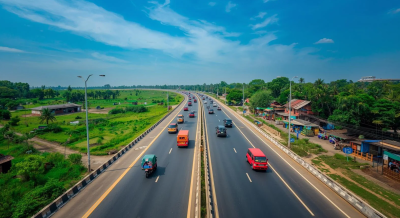
The Supreme Court of India has declared the Right to Safe Travel on National Highways a fundamental right under Article 21 of the Indian Constitution, which guarantees the Right to Life and Personal Liberty. This landmark judicial intervention addresses the rising frequency of fatal road accidents across the country. The apex court ruled that the state holds a strict constitutional obligation to maintain safe, motorable, and hazard-free roads rather than treating road safety as a mere policy objective. The ruling elevates infrastructure maintenance and commuter safety to legally enforceable state duties.
The Crisis of Highway Fatalities in India
The Supreme Court ruling directly responds to a sharp inflation in road traffic accidents and fatalities on high-speed corridors.
Statistical Imbalance of National Highways
- Road Share vs. Fatality Ratio: National Highways constitute only about 2% of the total road network length in India. However, they account for over 30% of total national road crash fatalities.
- Recent Casualty Figures: Official data presented to the court revealed that national highways recorded over 26,000 deaths in just the first half of 2025.
- Economic Cost: The World Bank estimates that road crash injuries and fatalities cost the Indian economy between 3% and 5% of its Gross Domestic Product annually due to loss of productivity and medical expenses.
Primary Causes of Highway Accidents
- Structural Engineering Defects: Poorly designed entry and exit points, missing service lanes, blind spots, and inadequate warning signage on high-speed stretches.
- Enforcement Gaps: Ineffective monitoring of over-speeding, wrong-way driving, overloading of commercial vehicles, and lack of automated speed trap networks.
- Post-Crash Care Deficiencies: Delayed emergency response times during the critical “Golden Hour,” which is the first hour after a traumatic injury when prompt medical treatment has the highest likelihood of preventing death.
Judicial Architecture and Constitutional Foundations
The Supreme Court utilized its expansive interpretation of fundamental rights to establish new legal accountability for road infrastructure managers.
Article 21 Expansion
The court expanded the scope of the Right to Life by ruling that the right to live with human dignity inherently includes the right to move safely across state-built infrastructure. The state cannot collect toll taxes without ensuring corresponding safety measures, proper lighting, and emergency obstacle removal.
Article 142 Inherent Powers
The bench invoked Article 142 of the Constitution, which empowers the Supreme Court to pass any decree or order necessary for doing “complete justice” in any cause or matter pending before it. Under this power, the court issued mandatory interim guidelines for highway safety that carry the force of law until Parliament enacts specific replacing legislation.
Strategic Framework: The 4Es of Road Safety
The judicial directives support the union government’s target to reduce road accident fatalities by 50% by 2030. This objective relies on a multi-pronged strategy structured around four core pillars.
| Safety Pillar | Key Implementation Focus Areas |
| Education | Public awareness campaigns, strict driving license testing protocols, and school curriculum integration on traffic rules. |
| Engineering | Road design corrections, black spot identification, mandatory crash barriers, and pedestrian underpasses. |
| Enforcement | Implementation of the Motor Vehicles (Amendment) Act, electronic speed monitoring, and heavy penalties for driving violations. |
| Emergency Care | Setting up trauma centers along highway corridors, free cashless treatment during the Golden Hour, and training local communities as first responders. |
Mandatory Directives Issued by the Court
The Supreme Court outlined specific actions that the National Highways Authority of India and state governments must deploy immediately.
Infrastructure Upgrades
Highway operators must eliminate all identified “black spots”—stretches of road where accidents happen repeatedly—within a fixed timeframe. Automated speed enforcement cameras and high-definition closed-circuit television systems must be deployed every ten kilometers on major corridors.
Emergency Medical Response
Advanced Life Support ambulances must be stationed at every toll plaza location. The court mandated the creation of a unified highway helpline number integrated with regional trauma centers to minimize emergency response delays.
Accountability of Toll Operators
If an accident occurs due to unaddressed road defects, deep potholes, or poor lighting, the operating concessionaire or highway authority can be held legally liable for negligence. Toll collection rights can be suspended if an operator fails third-party safety audits.
IASPOINT Booster Facts for UPSC
- Nodal Ministry: The Ministry of Road Transport and Highways handles the formulation of broad policies relating to road safety, national highway construction, and transport administration.
- Statutory Authority: The National Highways Authority of India was set up under the National Highways Authority of India Act, 1988, and functions as an autonomous body under the Ministry of Road Transport and Highways.
- Good Samaritan Law: Section 134A of the Motor Vehicles (Amendment) Act protects individuals who voluntarily provide immediate medical or non-medical assistance to an accident victim from civil or criminal liability.
- Brasilia Declaration: India is a signatory to the Second Global High-Level Conference on Road Safety in Brazil, where nations committed to achieving the Sustainable Development Goal target 3.6 to reduce global road traffic deaths.
- Sundar Committee Report: The high-level committee on road safety and traffic management recommended the creation of a statutory National Road Safety Board to advise the government on engineering and traffic management standards.