
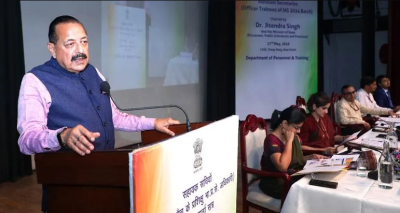
Women’s representation in the Indian Administrative Service reached a historic high of 41% in the 2024 batch, highlighting a fundamental shift toward the democratization of administrative opportunities across India. Union Minister Dr. Jitendra Singh emphasized this milestone during an interaction with the 184 officer trainees of the 2024 batch, noting that the changing demographic profile of the civil services mirrors the country’s broader socio-economic transformation. The current batch is undergoing the eight-week Assistant Secretary Programme in New Delhi, designed to provide early exposure to central policymaking and federal governance mechanisms before the officers transition to their respective state cadres.
Demographics and Diversity Trends
The composition of recent civil services batches shows an expansion of representation across gender lines, academic streams, and regional backgrounds.
Educational Profiles
The 2024 Indian Administrative Service batch contains diverse educational backgrounds, reducing the historic dominance of specific academic fields.
- Engineering Dominance: A total of 78 officers in the current batch come from engineering backgrounds.
- Interdisciplinary Inflow: The remaining officers hold degrees in medicine, law, management, and the humanities.
- Technocratic Governance: The presence of technically qualified officers aids the management of data-driven flagship programs like Digital India, clean energy grids, and smart city infrastructure.
Regional and Social Democratization
The intake demonstrates a shift away from traditional urban centers. Candidates are increasingly qualifying from states and tier-2 or tier-3 cities that historically had lower representation in the premier civil services. This diversification changes the institutional culture, making the executive branch more reflective of India’s actual demographic realities.
Assistant Secretary Programme and Training Reforms
The structural training of newly recruited civil servants has undergone updates to bridge the gap between field execution and central policy formulation.
The Onboarding Framework
The Assistant Secretary Programme attaches newly allocated officers directly to Union Ministries for an eight-week duration. The 2024 batch deployment spans from May 4 to June 25, 2026, across 49 Central Ministries and Departments.
Institutional Impact
- Early Exposure: Officers study the complex inter-ministerial coordination mechanisms and policy drafting styles early in their career.
- Systemic Understanding: This framework helps officers understand how field-level data inputs from districts influence macro-level central government planning.
- Crisis Management: Historical feedback shows that officers exposed to central structures manage district-level administrative crises with greater institutional confidence.
Evolution of Gender Representation in Civil Services
The growth of women in the administrative ranks has advanced from restrictive colonial-era legal barriers to high success rates in competitive examinations.
| Metric and Timeline | Historical Representation Status | Key Structural Drivers |
| 1951 Baseline | Anna George Malhotra became the first woman to clear the exam and join the service. | Overcoming initial post-colonial social resistance. |
| Pre-1972 Rule | The All India Services (AIS) Rules, 1954 forced female officers to resign upon marriage. | The restrictive provision was officially deleted from the rulebook in 1972. |
| Historical Average | Women accounted for only 13% of total recruitment between 1951 and 2020. | Totaled 1,527 women out of 11,569 officers over seven decades. |
| 2024/2025 Milestones | Women secured nearly 41% of total allocations, stabilizing female intake. | Driven by quadrupled female applicant numbers over fifteen years and targeted application fee waivers. |
Modern Governance and Capacity Building
The administrative criteria for running public institutions now require a shift from rigid colonial-era control to transparent, output-oriented public service.
Continuous Competency Upgradation
The Department of Personnel and Training focuses on continuous professional development via digital frameworks. The iGOT Karmayogi platform under Mission Karmayogi provides updated, self-paced capacity-building modules. Officers use this platform to build skills in artificial intelligence, big data analytics, and digital public infrastructure management.
Ethical and Accountable Execution
Modern governance demands accountability over mere process compliance. Administrators are trained to combine technological competence with administrative neutrality and public empathy. The governance objective targets meaningful public outcomes, matching the principles of Antyodaya to extend state benefits to the most marginalized citizens.
IASPOINT Booster Facts for UPSC
- Nodal Department for Training: The Department of Personnel and Training, operating under the Ministry of Personnel, Public Grievances and Pensions, is the cadre controlling authority for the Indian Administrative Service.
- Statutory Rules Change: The deletion of the discriminatory marriage rule in the All India Services Rules, 1954 was prompted by systemic legal challenges and administrative reviews regarding gender equality in the executive branch.
- State-Wise Cadre Variances: Historical data from the Trivedi Centre for Political Data indicates wide variations in female representation across state cadres. Punjab, Delhi, and Haryana maintain higher proportions of female officers, whereas Gujarat and Chhattisgarh have historically recorded lower percentages.
- First Woman IPS Officer: Kiran Bedi became the first woman to join the Indian Police Service in 1972, coinciding with the broader removal of gender-restrictive clauses across all All India Services.
- Grievance Redressal Benchmarks: Trainee officers are strictly mandated to master the Centralised Public Grievance Redress and Monitoring System (CPGRAMS) platform, which maintains a 98% disposal rate for public complaints across central departments.