
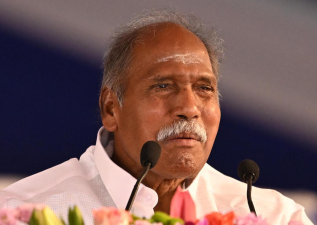
All India N.R. Congress founder N. Rangasamy was sworn in as the Chief Minister of Puducherry for a record fifth time on 13 May 2026. Lieutenant Governor K. Kailashnathan administered the oath of office and secrecy at a ceremony held at Lok Nivas. This milestone follows the National Democratic Alliance victory in the assembly elections, which concluded with vote counting on 4 May 2026. President Droupadi Murmu formally approved the appointment of the Chief Minister on 10 May 2026, paving the way for the government formation. Senior leaders Malladi Krishna Rao and A. Namassivayam also took oath as cabinet ministers during the same event.
Assembly Election Outcome and Seat Share
The 2026 Puducherry Legislative Assembly election resulted in the ruling National Democratic Alliance retaining power for a consecutive term. The legislative assembly consists of 30 elected seats, where a party or coalition needs 16 seats to achieve an absolute majority.
Party-Wise Performance
The political composition of the 30-member house following the election reflects a fragmented opposition alongside a consolidated ruling alliance:
- All India N.R. Congress (AINRC): Secured 12 seats, emerging as the single largest party in the house.
- Bharatiya Janata Party (BJP): Won 4 seats out of the 10 constituencies it contested.
- National Democratic Alliance Partners: The All India Anna Dravida Munnetra Kazhagam and Latchiya Jananayaga Katchi won 1 seat each, bringing the total elected strength of the ruling coalition to 18 seats.
- Dravida Munnetra Kazhagam (DMK): Won 5 seats to lead the regional opposition block.
- Tamilaga Vettri Kazhagam (TVK): Secured 2 seats during its debut electoral performance in the Union Territory.
- Indian National Congress (INC): Retained only 1 seat across the region.
- Other Parties and Independents: The Neyam Makkal Kazhagam secured 1 seat, while independent candidates won the remaining 3 seats.
Constitutional and Administrative Framework of Puducherry
Puducherry operates under a distinct constitutional setup compared to standard Indian states. The administrative and legislative systems are shaped by specific constitutional provisions.
Article 239A and Government Structure
The Union Territory of Puducherry is governed under Article 239A of the Constitution of India. This article empowers Parliament to create a local legislature and a Council of Ministers for the territory. The governance model designates the Lieutenant Governor as the constitutional head representing the Union Government, while the Chief Minister leads the elected Council of Ministers to run the day-to-day administration.
Cabinet Ceilings and Nominations
The composition of the Puducherry administration incorporates unique structural provisions:
| Feature | Details | Constitutional / Legal Basis |
| Cabinet Size Limit | Maximum of 10% of total assembly strength (3 ministers including the Chief Minister took the initial oath) | Government of Union Territories Act, 1963 |
| Nominated Members | Provision to nominate up to 3 additional non-elected members to the legislative assembly | Government of Union Territories Act, 1963 |
| Voting Rights | Nominated members possess full voting rights inside the house, identical to elected MLAs | Supreme Court ruling (K. Lakshminarayanan case) |
Political Profile of N. Rangasamy
The political journey of N. Rangasamy reflects the changing political landscape of the Union Territory over the past three decades.
Leadership and Tenure
N. Rangasamy holds the distinction of being the longest-serving Chief Minister of Puducherry. He first assumed the office of Chief Minister in 2001 as a leader of the Indian National Congress, serving until 2008. In 2011, he broke away from the Congress party to establish the regional outfit All India N.R. Congress. He immediately led his new party to power, serving his third term from 2011 to 2016. He returned to power for a fourth term in May 2021 by forming a coalition government with the Bharatiya Janata Party, a partnership that has been renewed following the 2026 electoral mandate.
IASPOINT Booster Facts for UPSC
- Four Non-Contiguous Regions: The Union Territory of Puducherry comprises four distinct geographical districts scattered across different states: Puducherry and Karaikal (enclaves within Tamil Nadu), Mahé (enclave within Kerala on the Malabar Coast), and Yanam (enclave within Andhra Pradesh near the Godavari delta).
- Fourteenth Constitutional Amendment Act, 1962: This amendment integrated the former French establishments of Pondicherry, Karaikal, Mahé, and Yanam into the Indian Union as a specified Union Territory and inserted Article 239A into the Constitution.
- The Government of Union Territories Act, 1963: This legislative act provides the statutory framework for the functioning of the Legislative Assembly and Council of Ministers in Puducherry, defining the boundary of powers between the local government and the union administrator.
- Nominated MLAs Judgement: In 2018, the Supreme Court of India upheld that the Central Government has the authority to nominate three members to the Puducherry Assembly without consulting the elected local government, and these members can vote on budget matters and no-confidence motions.
- Cabinet Composition Contrast: Unlike regular states where the 91st Constitutional Amendment Act limits the Council of Ministers to 15% of the assembly strength, Puducherry is bound by the 10% limit stipulated under the Government of Union Territories Act, 1963, restricting the cabinet size to a maximum of six ministers.