
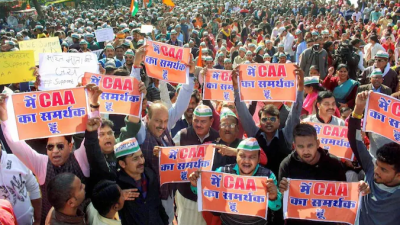
The Union Home Ministry has updated the Citizenship Rules under the Citizenship Amendment Act (CAA), 2019, making it mandatory for applicants to explicitly declare whether they hold or previously held valid or expired passports from Pakistan, Afghanistan, or Bangladesh. This regulatory change directly impacts several cross-border migrant groups, especially the Matua community in West Bengal, who migrated from Bangladesh over several decades and frequently lack formal documentation to prove their foreign origin. The new rules aim to streamline administrative records, establishing a legally binding protocol that requires the formal surrender of these foreign passports within fifteen days of receiving Indian citizenship while enforcing strict penalties for false background declarations.
Core Provisions of the Citizenship Amendment Act (CAA), 2019
The CAA serves as a specialized, fast-tracked legislative framework designed to regularize the status of specific undocumented migrants residing within Indian territories.
Eligible Beneficiaries and Statutory Timelines
The Act relaxes Indian citizenship requirements specifically for individuals belonging to six non-Muslim minority communities: Hindus, Sikhs, Buddhists, Jains, Parsis, and Christians. To qualify for accelerated naturalization, these individuals must have migrated from Afghanistan, Bangladesh, or Pakistan due to religious persecution or the fear of it, and entered India on or before the cutoff date of December 31, 2014.
Fast-Track Naturalization Pathway
Under the standard provisions of the Citizenship Act, 1955, an applicant seeking citizenship via naturalization must demonstrate a minimum residency period of eleven years in India. The 2019 amendment reduces this residency requirement to five years for the designated six minority groups, effectively creating an expedited path to full legal status.
Profile of the Matua Community and Historical Context
The socio-religious identity of the Matua community plays a central role in contemporary demographic and electoral dynamics along the eastern border of India.
Origin and Identity
The Matuas are Namasudras, a Dalit scheduled caste group that traces its origins to the socio-religious reformation movement started by Harichand Thakur in undivided Bengal during the mid-19th century. The movement arose as a protest against Brahmanical social exclusion, emphasizing equality, education, and inner spiritual devotion.
Migration Waves and Documentation Deficits
Following the Partition of India in 1947 and the Bangladesh Liberation War of 1971, millions of Matuas migrated from East Pakistan (now Bangladesh) into West Bengal, settling primarily in districts like North 24 Parganas and Nadia. Because many families crossed the international border under chaotic conditions without valid travel papers, they lack standard foreign state documents. This long-standing absence of birth certificates or passports has historically complicated their legal claims to Indian citizenship.
Decoding the Recent Amendment to Citizenship Rules
The Ministry of Home Affairs introduced the Citizenship (Amendment) Rules to fill gaps in tracking foreign documents and to standardize security checks.
Schedule 1C Passport Declaration
The amendment introduces an administrative paragraph in Schedule 1C of the citizenship application portal. Applicants must explicitly state whether they possess a valid or an expired foreign passport. If they hold or previously held such a document, they must supply exact details, including:
- Passport identification numbers
- Specific date of issue
- Official place of issue
- Expiry dates
Mandatory Surrender Protocol
Upon approval of Indian citizenship, applicants who declared possession of a foreign passport must surrender the physical document to the designated Senior Superintendent of Post or Superintendent of Post within fifteen calendar days. This measure systematically prevents the retention of dual travel documents, which is prohibited under Indian municipal law.
Accountability and Declaratory Checks
The amended framework binds applicants to an absolute verification standard. The updated forms feature a legal clause clarifying that any false declaration or concealment of an existing or expired passport will lead to an immediate forfeiture of the application, alongside potential deprivation of Indian citizenship post-approval.
Constitutional and Geographical Exemptions under CAA
The application of the CAA is restricted geographically to protect indigenous communities and autonomous tribal zones.
Sixth Schedule Exemptions
The provisions of the CAA do not apply to the tribal areas of Assam, Meghalaya, Mizoram, and Tripura that are governed under the Sixth Schedule of the Indian Constitution. These protected enclaves include:
- Karbi Anglong, Dima Hasao, and Bodoland Territorial Council districts in Assam
- Garo Hills, Jaintia Hills, and Khasi Hills autonomous zones in Meghalaya
- Chakma and Lai districts in Mizoram
- Tripura Tribal Areas Autonomous District
Inner Line Permit (ILP) Protections
The fast-tracked citizenship provisions are barred from operating in territories regulated by the Inner Line Permit system under the Bengal Eastern Frontier Regulation, 1873. This system shields the demographic and cultural status of specific states, currently encompassing:
- Arunachal Pradesh
- Mizoram
- Nagaland
- Manipur
IASPOINT Booster Facts for UPSC
- Parent Legislation: The Citizenship Act, 1955 regulates the acquisition and termination of Indian citizenship via five established modes: birth, descent, registration, naturalization, and incorporation of foreign territory.
- Constitutional Domain: Matters relating to citizenship fall under the exclusive legislative domain of the Union Parliament, governed by Article 5 to Article 11 under Part II of the Constitution of India.
- Nodal Ministry: The Ministry of Home Affairs serves as the sole nodal administrative authority for processing applications, verifying records, and granting naturalization certificates.
- Dual Citizenship Prohibition: The Constitution of India explicitly bars dual citizenship under Article 9. A person automatically loses Indian citizenship if they voluntarily acquire the citizenship of another nation.
- Facilitative Clause Expansion: To ease document requirements for undocumented communities, the Ministry of Home Affairs previously expanded Schedule 1A to permit Indian state or central government papers, or quasi-judicial documents, to help establish an applicant’s ancestral roots.
- Faith Certification Authority: Under the notified CAA implementation rules, local priests or recognized community institutions are legally authorized to issue faith-validating certificates to confirm the religious minority status of applicants.