
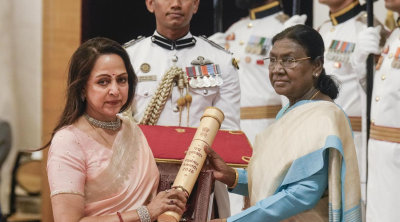
President Droupadi Murmu presented the Padma Awards for 2026 at the Civil Investiture Ceremony-I held at Rashtrapati Bhavan in New Delhi on May 25, 2026. For the year 2026, the President approved a total of 131 Padma Awards, comprising 5 Padma Vibhushan, 13 Padma Bhushan, and 113 Padma Shri awards. The annual civilian honors recognize outstanding contributions across various domains such as public affairs, art, social work, medicine, literature, and sports. The first round of the investiture ceremony witnessed the presentation of 66 awards, including two Padma Vibhushan, six Padma Bhushan, and 58 Padma Shri honors.
Categorized Breakdown of 2026 Winners
The awards are stratified into three distinct tiers based on the nature of the service rendered to the nation.
Padma Vibhushan Recipients
The highest tier among the Padma honors was conferred upon five individuals for exceptional and distinguished service.
- Shri Dharmendra Singh Deol (Posthumous): Conferred in the field of Art (Cinema) from Maharashtra; received by his wife, Lok Sabha MP Hema Malini.
- Ms. N. Rajam: Awarded in the field of Art (Classical Violin Violin Virtuoso) from Uttar Pradesh.
- Shri K. T. Thomas: Conferred for his contributions to Public Affairs from Kerala.
- Shri P. Narayanan: Awarded for his work in Literature and Education from Kerala.
- Shri V. S. Achuthanandhan (Posthumous): Conferred for lifetime service in Public Affairs from Kerala.
Padma Bhushan Recipients
Thirteen eminent personalities were selected for distinguished service of a high order. The recipients honored in the first phase include:
- Shri Bhagat Singh Koshyari: Public Affairs (Former Uttarakhand Chief Minister and Maharashtra Governor).
- Shri Uday Suresh Kumar Kotak: Trade and Industry (Founder of Kotak Mahindra Bank).
- Dr. Kallipatti Ramasamy Palaniswamy: Medicine (Gastroenterology, Tamil Nadu).
- Shri Shatavadhani R. Ganesh: Art (Revival of the classical art form of Avadhana, Karnataka).
- Shri Piyush Pandey (Posthumous): Art (Advertising veteran, Maharashtra).
- Shri Vijay Kumar Malhotra (Posthumous): Public Affairs (Former Member of Parliament, Delhi).
- Other approved recipients for 2026 include Ms. Alka Yagnik (Art), Shri Mammootty (Art), Dr. Nori Dattatreyudu (Medicine), Shri S. K. M. Maeilanandhan (Social Work), Shri Shibu Soren (Posthumous – Public Affairs), Shri Vellappally Natesan (Public Affairs), and Shri Vijay Amritraj (Sports).
Prominent Padma Shri Recipients
The third-tier award for distinguished service was presented to 113 individuals, featuring several grassroots achievers:
- Ms. Harmanpreet Kaur Bhullar: Sports (Indian Women’s Cricket Team Captain).
- Shri K. Vijay Kumar: Civil Service (Former Director-General of the Central Reserve Police Force).
- Shri Praveen Kumar: Sports (Para-athletics).
- Shri Prosenjit Chatterjee: Art (Cinema, West Bengal).
- Ms. Kollakal Devaki Amma G.: Social Work (Environmental conservation, Kerala).
- Shri K. Pajanivel: Sports (Promotion of the ancient martial art Silambam, Puducherry).
- Shri Baldev Singh: Sports (Hockey coach, Punjab).
- Dr. Ramchandra Godbole and Ms. Suneeta Godbole (Duo): Medicine/Social Work (Healthcare delivery in tribal areas).
Statutory Framework and Constitutional Rules
The structural operations, eligibility criteria, and legal limitations of the Padma Awards follow a specific constitutional framework.
Historical Evolution
The Government of India instituted two civilian awards in 1954: the Bharat Ratna and the Bharat Ratna sub-divisions initially named Pahela Varg, Dusra Varg, and Tisra Varg. A Presidential Notification issued on January 8, 1955, re-designated these sub-divisions as the Padma Vibhushan, Padma Bhushan, and Padma Shri respectively.
Constitutional Mandate on Titles
According to Article 18(1) of the Constitution of India, the state cannot confer any titles except for military or academic distinctions. The Supreme Court of India upheld the validity of the Padma Awards in the landmark Balaji Raghavan v. Union of India (1995) case. However, the court ruled that these awards are decorations and cannot be used as prefixes or suffixes to the recipient’s name. Any such usage leads to the forfeiture of the award.
Selection Procedure
The Padma Awards Committee, constituted by the Prime Minister every year, processes all nominations. The committee is headed by the Cabinet Secretary and includes the Home Secretary, Secretary to the President, and four to six eminent individuals as members. The recommendations are submitted to the Prime Minister and the President for final approval.
Operational Metrics and Institutional Criteria
The processing framework follows strict guidelines regarding numerical caps, fields of activity, and employment restrictions.
Quantitative Ceiling
The total number of Padma awards given in a single year cannot exceed 120. However, this statutory limit excludes NRI/OCI/Foreign recipients and posthumous awards.
Fields Covered
The awards recognize performance and service across diverse fields:
- Art: Music, painting, sculpture, photography, cinema, and theatre.
- Social Work: Social service, charitable service, and contribution in community projects.
- Public Affairs: Law, public life, and politics.
- Science & Engineering: Space engineering, nuclear science, information technology, and research.
- Trade & Industry: Banking, economic growth, management, and business.
- Medicine: Medical research, clinical specialization, and alternative medicine.
- Literature & Education: Journalism, teaching, book promotion, and linguistic research.
- Civil Service: Excellence in government administration.
- Sports: Athletics, mountaineering, cricket, and sports coaching.
Exclusionary Rules
Public sector employees and government servants, including those working with Public Sector Undertakings (PSUs), are explicitly excluded from eligibility. An exception is made only for doctors and scientists, who remain eligible irrespective of their government employment status.
| Award Category | Conferred For | 2026 Total Count |
| Padma Vibhushan | Exceptional and distinguished service | 5 |
| Padma Bhushan | Distinguished service of a high order | 13 |
| Padma Shri | Distinguished service in any field | 113 |
| Total | All Categories | 131 |
IASPOINT Booster Facts for UPSC
- Posthumous Constraint: The statutes dictate that the Padma award is not generally conferred posthumously. However, the government can consider highly deserving cases if the demise of the person occurred recently, specifically within one year preceding the Republic Day announcement.
- The Interregnum Exceptions: The Padma awards have been announced every single year on Republic Day since 1954 except during brief periods of political or judicial suspension, specifically in the years 1977, 1978, 1979, 1993, 1994, and 1995.
- The Monogram Regulations: The decoration comprises a circular medal. The geometric pattern is a burnished bronze medallion with a replica of the lotus flower embossed in the center. The words “Padma” and “Vibhushan/Bhushan/Shri” are inscribed in Devanagari script.
- The Higher Tier Upgradation Rule: A recipient can be conferred a higher tier of the Padma award only after a minimum period of five years has elapsed since the conferment of the previous Padma award. Relaxation can be made by the committee in highly exceptional cases.
- No Cash Component: The awards do not carry any monetary allowance, cash grant, or complementary facilities like free rail/air travel, distinguishing them completely from gallantry awards.
- Self-Nomination Facility: The nomination process is completely open to the public. Self-nomination is legally permissible through the centralized online portal managed by the Ministry of Home Affairs.