
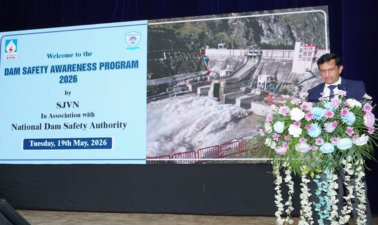
The National Dam Safety Authority (NDSA) conducted a community awareness programme on dam safety at the Nathpa Jhakri Hydro Power Project in Himachal Pradesh on May 19, 2026. The initiative focused on strengthening disaster preparedness, public risk awareness, and institutional coordination among local communities, disaster management agencies, and administrative officials. Structured around the mandates of the Dam Safety Act 2021, the event detailed early warning systems, real-time monitoring technologies, and emergency response frameworks. The programme also featured field activities, including a public awareness march and a tree plantation drive, to encourage community-led ecological and hazard mitigation efforts in the high-risk Himalayan river valley.
Institutional Framework and Statutory Mandates
The Dam Safety Act 2021
The Dam Safety Act 2021 provides a legal framework for the surveillance, inspection, operation, and maintenance of specified dams across India to prevent dam-failure related disasters. It applies to all dams higher than 15 meters, and dams between 10 and 15 meters that meet specific structural or reservoir capacity criteria. The Act establishes a two-tier structure at both the central and state levels to enforce safety standards and handle non-compliance.
National Dam Safety Authority (NDSA)
The NDSA functions as the central regulatory body tasked with implementing safety policies, resolving interstate dam disputes, and maintaining a national database of dam failures. It lays down standard guidelines for Emergency Action Plans (EAPs), risk assessment studies, and comprehensive dam safety reviews.
State-Level Implementation Bodies
- State Committee on Dam Safety (SCDS): Formulates safety policies and oversees localized dam safety instrumentation at the state level.
- State Dam Safety Organisation (SDSO): Conducts routine structural inspections, monitors dam health parameters, and ensures that dam owners maintain proper operational logs.
Technical Profile of Nathpa Jhakri Hydro Power Project
Project Location and River System
The Nathpa Jhakri Hydro Power Project is a run-of-the-river facility constructed on the Satluj River in the Shimla and Kinnaur districts of Himachal Pradesh. It forms a critical component of the Satluj river basin development roadmap.
Power Generation and Operating Agency
The project has an installed capacity of 1,500 Megawatts (MW), generating power through six 250 MW Francis turbine units. It is owned and operated by SJVN Limited, a joint venture between the Government of India and the Government of Himachal Pradesh.
Structural Parameters
- Dam Type: Concrete gravity dam.
- Height and Length: The dam stands 62.5 meters tall from the deepest foundation level and has a crest length of 185 meters.
- Desilting Chambers: The project features four large underground desilting chambers, each measuring 525 meters in length. These chambers remove heavy quartz silt from the water before it enters the headrace tunnel to protect the turbine runners from high-velocity abrasive wear.
- Headrace Tunnel: Water travels through a 27.4-kilometer-long headrace tunnel, which ranks among the longest hydro-technical water conductor tunnels in the world.
Dam Safety Monitoring and Emergency Systems
Early Warning Systems (EWS)
Dams in mountain ecosystems require integrated telemetry systems to detect sudden hydrological changes. The Nathpa Jhakri project relies on real-time inflow forecasting networks located upstream in the Satluj catchment area to monitor glacial melt and sudden cloudburst runoff.
Technical Instrumentation for Structural Health
Engineers install multiple sensor arrays within the dam body to monitor structural integrity and detect early signs of distress:
- Piezometers: Measure pore water pressure inside the concrete foundation and surrounding rock strata.
- Inclinometers and Extensometers: Detect internal structural shifts, tilt variations, and rock mass movements.
- Seismographs: Record local tectonic activity and gauge the dam’s response to seismic shocks in the seismically active Himalayan zone.
Emergency Action Plan (EAP)
An EAP maps out clear operational procedures for dam operators during extreme flood inflows or structural emergencies. The plan defines evacuation zones, identifies safe assembly areas, and establishes direct communication lines with the National Disaster Response Force (NDRF), State Disaster Response Force (SDRF), and district administrations.
Comparative Classification of Indian Dam Safety Bodies
| Regulatory Tier | Central Level Body | State Level Body | Primary Structural Function |
| Policy Formulation | National Committee on Dam Safety (NCDS) | State Committee on Dam Safety (SCDS) | Devises safety regulations, checks maintenance standards, and recommends structural modifications. |
| Regulatory Enforcement | National Dam Safety Authority (NDSA) | State Dam Safety Organisation (SDSO) | Enforces guidelines, investigates structural failures, oversees regular inspections, and compiles safety reports. |
IASPOINT Booster Facts for UPSC
- Seismic Vulnerability: The Nathpa Jhakri project is located in Seismic Zone V, the highest risk category on India’s seismic zone map. This location requires specialized earthquake-resistant design provisions for all subterranean and surface structures.
- The Satluj River Origin: The Satluj River originates from the Rakshastal Lake near Mount Kailash in Tibet, where it is known as the Langqên Zangbo. It enters India through the Shipki La pass in the Kinnaur district of Himachal Pradesh.
- National Register of Large Dams (NRLD): Compiled by the Central Water Commission (CWC), the NRLD is a national repository that tracks structural data on all large dams across the country. India ranks third globally in terms of the total number of large dams, trailing only China and the United States.
- Glacial Lake Outburst Floods (GLOF): High-altitude dams in Himachal Pradesh face unique operational risks from GLOFs. These events occur when unstable moraine dams containing glacial lakes fail, releasing massive volumes of water and debris downstream.
- Punitive Clauses in the Act: The Dam Safety Act 2021 includes strict penal provisions for non-compliance. Dam owners or operators who obstruct safety officials or refuse to implement emergency safety measures face prison terms of up to two years.
- Run-of-the-River Model: Unlike conventional storage dams that flood vast valleys to create massive reservoirs, run-of-the-river projects like Nathpa Jhakri divert flowing river water through tunnels to generate electricity before returning the full volume back to the natural riverbed downstream.