
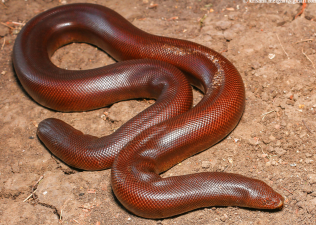
The Hyderabad unit of the Directorate of Revenue Intelligence (DRI) recently seized two live Indian Red Sand Boas (Eryx johnii) from an illegal wildlife trader in Warangal, Telangana. Acting on specific intelligence, DRI officials used an undercover decoy operation to intercept the trade. The Indian Red Sand Boa is a protected species under Schedule I of the Wildlife (Protection) Act, 1972, making any unauthorized possession, trade, or transport a severe criminal offense. Following the interception, the DRI handed over the seized snakes and the accused to the Warangal Forest Range Officer for legal prosecution under wildlife laws.
Taxonomy and Physical Characteristics
Morphological Features and the “Two-Headed” Myth
The Indian Red Sand Boa is a non-venomous snake species adapted for burrowing. It has a thick, cylindrical body with small scales, a blunt head, and a remarkably blunt tail that resembles its head. This physical trait serves as a defense mechanism to confuse predators, leading to the widespread, erroneous belief that the snake has two heads.
Coloration and Habitat
The species typically displays a reddish-brown, sand-coloured, or dark grey body. It grows to an average length of 75 to 100 cm. It prefers dry, arid, and semi-arid regions with loose, sandy soil that allows it to burrow easily. It avoids thick forests and wet ecosystems.
Geographic Distribution and Range
The Indian Red Sand Boa is native to the Indian subcontinent and parts of West Asia.
- India: It is widely distributed across the Indian mainland, with prominent populations in states like Rajasthan, Gujarat, Maharashtra, Andhra Pradesh, Telangana, Karnataka, and Tamil Nadu.
- Regional Range: The species is also found in Iran, Pakistan, and Nepal.
Drivers of Illegal Wildlife Trade
Superstition and Black Magic
The primary driver behind the rampant smuggling of the Red Sand Boa is deep-rooted superstition. Traffickers exploit beliefs that the snake brings good fortune, can locate hidden treasures, or possesses supernatural powers used in black magic rituals.
Underground Markets and False Medicinal Claims
The snake fetches high prices in illegal domestic and international markets. Smugglers falsely claim that secretions or body parts of the snake can cure chronic ailments, including HIV/AIDS, cancer, and skin diseases. There is no scientific validation for these claims.
Legal Status and Conservation Framework
Wildlife (Protection) Act, 1972
In India, the Red Sand Boa is placed under Schedule I of the Wildlife (Protection) Act, 1972. This classification grants it the highest level of legal protection, equal to that of tigers and elephants. Violations carry stringent penalties, including mandatory imprisonment.
International Conventions and Status
The species is protected internationally to prevent cross-border trafficking and monitor population declines.
| Convention/Organization | Status/Classification | Implications |
| IUCN Red List | Near Threatened (NT) | Reflects a declining wild population due to habitat loss and poaching. |
| CITES | Appendix II | Regulates and monitors international trade to ensure it does not threaten survival. |
Threats and Enforcement Agencies
The species faces dual threats from habitat fragmentation due to expanding agriculture and targeted poaching for the pet trade or occult practices. Multiple enforcement agencies work together to curb this illegal trade network.
- State Forest Departments: Serve as the primary enforcement and custodial bodies for local wildlife protection.
- Directorate of Revenue Intelligence (DRI): Acts as the apex anti-smuggling agency under the Central Board of Indirect Taxes and Customs (CBIC) to intercept commercial wildlife trafficking at state and international borders.
- Wildlife Crime Control Bureau (WCCB): A statutory body that gathers intelligence, coordinates multi-agency operations, and maintains wildlife crime data.
IASPOINT Booster Facts for UPSC
- The Ovoviviparous Nature: Unlike many other snakes that lay eggs, the Red Sand Boa is ovoviviparous. Females give birth to live young after the eggs hatch inside the mother’s body.
- Ecological Role: The species acts as a natural pest control agent. Its diet primarily consists of rodents, lizards, and small mammals, helping maintain agricultural balance.
- DRI Authority: While the DRI primarily handles economic offenses and commercial smuggling, it derives powers to seize wildlife under Section 11 of the Customs Act, 1962, read alongside the Wildlife (Protection) Act.
- Recent Legal Amendment: The Wildlife (Protection) Amendment Act, 2022, rationalized schedules from six down to four, moving the Red Sand Boa into the newly structured Schedule I to maintain strict penal provisions.