
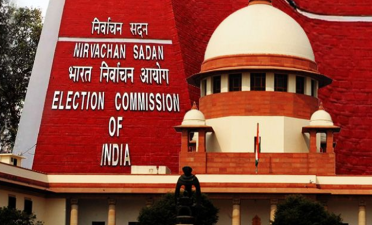
The Supreme Court of India on 14 May 2026 reviewed petitions challenging the Chief Election Commissioner and Other Election Commissioners (Appointment, Conditions of Service and Term of Office) Act, 2023. The law replaces the Chief Justice of India with a Union Cabinet Minister on the three-member selection panel, alongside the Prime Minister and the Leader of the Opposition. The bench raised concerns regarding the executive’s two-to-one majority on the panel and its impact on institutional independence. The Court also sought the official records concerning the March 2024 appointments of Election Commissioners Gyanesh Kumar and S. S. Sandhu under this statutory framework.
Constitutional Framework of the Election Commission
The Constitution provides the baseline structure for the Election Commission of India (ECI) to ensure its functioning remains free from executive interference.
Article 324 and the Mandate for Elections
Article 324 vests the superintendence, direction, and control of elections in the Election Commission. This mandate covers elections to Parliament, State Legislatures, and the offices of the President and Vice-President of India.
Evolution of the Commission’s Structure
The ECI operated as a single-member body from its inception in 1950 until 1989. The President appointed two additional Election Commissioners in October 1989, but abolished the posts in January 1990. The Chief Election Commissioner and other Election Commissioners (Conditions of Service) Amendment Ordinance, 1993, permanently converted the ECI into a three-member body. The Chief Election Commissioner (CEC) and the two Election Commissioners (ECs) hold equal voting power, and decisions are made by a majority vote.
The Chief Election Commissioner and Other Election Commissioners Act, 2023
The 2023 Act established a formal, statutory mechanism for appointing members of the ECI, replacing the previous practice where the executive made appointments independently.
The Two-Stage Appointment Panel
The statutory selection process utilizes a dual-panel framework to filter and select candidates:
- Search Committee: Headed by the Cabinet Secretary, this panel includes two other members not below the rank of Secretary to the Government of India. It prepares a panel of five names for the selection committee’s consideration.
- Selection Committee: A three-member panel that reviews the recommendations and finalizes the appointments. The President formally appoints the chosen candidates based on these recommendations.
Composition of the Selection Panel
The 2023 Act structures the core selection committee to give the ruling executive a clear majority in the decision-making process.
| Panel Member | Role on Committee | Institutional Branch |
| Prime Minister | Chairperson | Executive |
| Leader of the Opposition in Lok Sabha | Member | Legislature |
| Union Cabinet Minister | Member (Nominated by PM) | Executive |
Qualifications and Service Conditions
Candidates must hold or have held a post equivalent to the rank of Secretary to the Government of India. They must possess knowledge and experience in the management and conduct of elections. The term of office is six years from the date of assumption or until attaining the age of 65 years, whichever occurs earlier. The Act equates the salary, allowances, and service conditions of the CEC and ECs to those of a Supreme Court Judge.
Judicial Interventions and Institutional Balance
The legislative framework developed directly in response to judicial guidelines aiming to safeguard the independence of the election machinery.
The Anoop Baranwal v. Union of India Verdict (March 2023)
A five-judge Constitution Bench ruled that the absence of a law enacted by Parliament left a legislative vacuum under Article 324(2). The Court mandated that until Parliament passed a law, appointments must be made on the advice of a committee comprising the Prime Minister, the Leader of the Opposition in the Lok Sabha, and the Chief Justice of India.
Core Grounds of the 2026 Legal Challenge
The petitioners argue that replacing the Chief Justice of India with a Cabinet Minister violates the separation of powers and the basic structure of the Constitution. The Supreme Court bench expressed concern that a panel configuration allowing a two-to-one executive majority could dilute the independent status of the ECI. The Court is examining whether the current composition satisfies the constitutional requirement for free and fair elections.
IASPOINT Booster Facts for UPSC
- Removal Protection Disparity: The CEC can only be removed from office in like manner and on the like grounds as a Judge of the Supreme Court. However, the President can remove the other ECs based on the specific recommendation of the CEC.
- Dinesh Goswami Committee (1990): This committee recommended that the President should appoint the CEC in consultation with the Chief Justice of India and the Leader of the Opposition.
- National Commission to Review the Working of the Constitution (NCRWC): The 2002 commission suggested a committee consisting of the Prime Minister, Leader of the Opposition, Speaker of Lok Sabha, and Deputy Chairman of Rajya Sabha for ECI appointments.
- First Chief Election Commissioner: Sukumar Sen served as India’s first CEC from 21 March 1950 to 19 December 1958, supervising the first two general elections.
- V.S. Ramadevi Milestone: She remains the only woman to serve as the Chief Election Commissioner of India, holding the office for a brief tenure in late 1990.
- Post-Retirement Bar: The 2023 Act does not contain a clause bartering CEC and ECs from accepting further diplomatic, political, or administrative employment under the Government after retirement.