
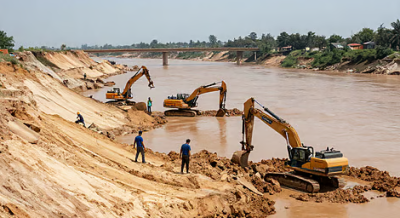
The Supreme Court of India took suo motu cognisance of rampant illegal sand mining inside the National Chambal Sanctuary, which threatens endangered riverine species such as the gharial and the freshwater river dolphin. Highlighting severe institutional paralysis and administrative apathy, a bench comprising Justices Vikram Nath, Sandeep Mehta, and Vijay Bishnoi reprimanded state authorities for failing to control organized mining mafias. On 14 May 2026, the apex court issued strict directives mandating the installation of high-resolution, Wi-Fi-enabled CCTV cameras on illegal sand extraction routes. Top bureaucrats from Rajasthan were summoned to appear personally on 20 May 2026 to present compliance reports, with the court warning of paramilitary forces deployment if state machineries fail to curb the ecological degradation.
Ecological Dimensions and Conservation Threats
The National Chambal Sanctuary faces severe environmental pressure due to illegal sand excavation along its riverbanks, directly compromising South Asia’s unique river valley ecosystem.
Threatened Flagship Species
- Gharial (Gavialis gangeticus): Critically endangered fish-eating crocodiles that depend entirely on undisturbed, clean sandbanks for nesting and basking. Sand mining destroys these specialized breeding grounds, crushing eggs and disrupting the population dynamics.
- Ganges River Dolphin (Platanista gangetica): Endangered freshwater mammals that rely on deep river pools and natural water flow profiles. Unregulated sand dredging alters underwater topography, increases turbidity, and destroys the fish populations they feed on.
- Red-Crowned Roofed Turtle (Batagur kachuga): A critically endangered freshwater turtle species whose nesting sites on sandy river islands are obliterated by heavy machinery.
Habitat Fragmentation and Ecological Restoration
The Central Empowered Committee highlighted that unscientific sand extraction causes severe bank erosion, lowers the water table, and alters natural river hydrology. The Supreme Court has directed State Pollution Control Boards to assess and recover environmental compensation from violators to fund long-term ecological restoration.
Judicial Directives and Enforcement Logistics
The Supreme Court has established an intensive legal and operational surveillance structure to counter organized mining activities across state boundaries.
Technological Surveillance and Monitoring
- Wi-Fi Enabled CCTV Infrastructure: States are required to deploy high-resolution, real-time CCTV cameras along identified vulnerable transit networks and clandestine extraction points.
- Live Control Rooms: Police and forest departments must establish dedicated round-the-clock control monitoring centers to track live feeds and dispatch quick-reaction interception teams.
- GPS Tracking: The judiciary suggested integrating global positioning system tracking monitors on all heavy machinery operating in adjacent districts, including loaders, tippers, and excavators.
Transport Violations and Vehicle Seizures
The Court expressed serious concern over the unchecked movement of unregistered tractors and commercial loaders violating the Motor Vehicles Act, 1988, and the Central Motor Vehicles Rules. In investigating these operations, the judiciary noted a disturbing pattern where enforcement agencies confined prosecutions to low-level drivers. Consequently, the court ordered states to actively target the actual financiers and masterminds of the illegal trade.
Enforcement Statistics for Rajasthan (Since 2023)
To assess ground-level compliance, the court reviewed the enforcement matrix submitted by the state of Rajasthan, which reflects ongoing penal actions against the mining network:
| Enforcement Parameter | Action Metrics |
| Registered Illegal Mining Cases | 158 Cases |
| Seized Transportation Vehicles | 144 Vehicles |
| Compounding Penalties and Fines Collected | Earmarked at approximately 89 Lakh INR |
| Established Surveillance Compliance | Only 1 active camera functional out of 40 identified vulnerable locations |
Institutional Coordination and Infrastructure Protection
The tri-state distribution of the sanctuary necessitates highly integrated institutional governance to manage cross-border law enforcement challenges.
Inter-State Coordination Deficiencies
The National Chambal Sanctuary forms a narrow eco-reserve co-administered by Rajasthan, Madhya Pradesh, and Uttar Pradesh. The Central Empowered Committee flagged critical coordination gaps where mining operators slip across state river borders to evade localized police jurisdictions, requiring a unified, tri-state Special Task Force.
Impleadment of the National Highways Authority of India
The amicus curiae revealed that illegal sand miners were excavating riverbeds directly beneath the foundation pillars of a vital inter-state bridge on National Highway-44 connecting Rajasthan and Madhya Pradesh. This extraction has formed deep water-filled cavities, compromising the bridge’s structural safety. In response, the Supreme Court impleaded the National Highways Authority of India as a primary respondent, ordering a detailed affidavit on structural protection plans and mandating the authority to evaluate setting up dedicated highway CCTV gantries.
IASPOINT Booster Facts for UPSC
- National Chambal Sanctuary Profile: Established first in Madhya Pradesh in 1978, it is India’s first and only tri-state riverine protected area, covering a total eco-zone of approximately 5,400 square kilometers across Rajasthan, Madhya Pradesh, and Uttar Pradesh.
- Boundary Rationalization Controversy: The Supreme Court placed an interim stay on a December 2025 notification by the Government of Rajasthan that attempted to unilaterally denotify 732 hectares of sanctuary land under Section 18 of the Wild Life (Protection) Act, 1972, ruling that states cannot execute boundary reductions without prior statutory approval from the National Board for Wild Life.
- Central Empowered Committee (CEC): Initially established by the Supreme Court in 2002 to monitor compliance with environmental orders, it was institutionalized as a permanent statutory body under the Environment (Protection) Act, 1986, to advise the central government on wildlife conservation.
- Universal Legal Standing of Riverine Wildlife: Under the Wild Life (Protection) Act, 1972, both the Gharial and Ganges River Dolphin are listed under Schedule I, granting them the highest level of statutory protection and prescribing severe criminal penalties for habitat destruction.