
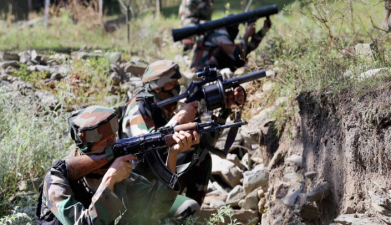
The Government of Mizoram signed a historic Memorandum of Settlement with the Lalhmingthanga Sanate-led faction of the Hmar People’s Convention (Democratic) at Sakawrdai on 14 April 2026. This bilateral peace accord culminated in a formal “Homecoming and Arms Laying Ceremony” on 30 April 2026 at the Central Training Institute Parade Ground in Sesawng, near Aizawl. During the event, 43 active insurgent cadres surrendered their weapons and swore an oath to reintegrate into mainstream society. This disarmament process successfully concludes the final chapter of armed ethnic militancy in Mizoram, rendering the state entirely insurgency-free.
Historical Context of the Hmar Insurgency
The Hmar people are a trans-border tribal community belonging to the larger Chin-Kuki-Mizo ethnic group. They reside across contiguous hills in Mizoram, Manipur, Assam, Meghalaya, and Tripura.
Genesis of the Conflict
The origins of the armed movement date back to 1986, following the signing of the historic Mizoram Peace Accord between the Government of India and the Mizo National Front. While the accord brought peace to the larger Mizo population, the Hmar tribal leadership felt marginalized and excluded from administrative representation. In 1986, the Hmar People’s Convention was formed as a political platform. The organization quickly militarized, launching an armed struggle for self-governance and demanding a separate Autonomous District Council under the Sixth Schedule of the Indian Constitution for Hmar-inhabited areas in northern and northeastern Mizoram.
Subsequent Splits and Democratic Factions
The insurgent landscape witnessed structural fragmentation over the decades due to ideological differences:
- The 1994 Accord: The Mizoram government signed a peace pact with the parent group, leading to the creation of the Sinlung Hills Development Council.
- Formation of HPC-(D): Dissatisfied with the limited executive powers of the 1994 council, a breakaway faction led by Lalhmingthanga Sanate formed the Hmar People’s Convention (Democratic) in 1994 to continue the armed struggle from bases in Assam’s Cachar district.
- The 2018 Transition: Another major faction of the group entered a Memorandum of Settlement with the state government, resulting in the upgrading of the administrative body into the Sinlung Hills Council. The Sanate-led faction remained outside this framework until the latest negotiations.
Institutional Provisions of the 2026 Accord
The 2026 Memorandum of Settlement prioritizes socio-economic rehabilitation and administrative upgrading over structural political reorganization.
Socio-Economic and Infrastructure Development Blueprint
The settlement includes targeted structural welfare interventions for the Hmar-dominated regions:
- Budgetary Enhancements: A special development package and increased annual budgetary support for the Sinlung Hills Council, starting from the 2027–28 fiscal year.
- Connectivity Projects: Funding for internal road networks, including upgrades to the critical Mauchar road and the construction of the Unity Bridge.
- Educational Amenities: Commitments to establish an Eklavya Model Residential School and a Netaji Subhash Chandra Bose Awasiya Vidyalaya hostel within the council’s jurisdiction.
- Administrative Shifts: Shifting the supervisory control of the Sinlung Hills Council from the General Administration Department to the District Council and Minority Affairs Department.
Cultural and Festivity Recognitions
To protect and honor the identity of the tribe, the accord institutes formal cultural concessions:
- Sikpui Ruoi: The largest winter harvest festival of the Hmar community, celebrated annually on December 5, is granted official recognition as a local holiday within the council zone.
- Hmar Martyrs’ Day: Observed on May 16, this day receives official local recognition to commemorate historical tribal struggles.
Structural Matrix of Peace Accords in Mizoram
The resolution of ethnic conflict in Mizoram provides an instructional template for internal security frameworks.
| Year of Accord | Signatory Entity | Core Institutional Outcome | Current Status |
| 1986 | Mizo National Front (MNF) & Government of India | Upgrade to full statehood for Mizoram; surrender of underground cadres. | Formed the bedrock of peace in Mizoram. |
| 1994 | Hmar People’s Convention (HPC) Parent Body | Creation of the Sinlung Hills Development Council (SHDC). | Dissolved after failing to satisfy local autonomy demands. |
| 2018 | Hmar People’s Convention (Democratic) – Main Faction | Upgraded the SHDC into the Sinlung Hills Council (SHC) with statutory powers over 31 villages. | Functional administrative unit in northern Mizoram. |
| 2026 | HPC-(D) Lalhmingthanga Sanate Faction | Complete disarmament of the last 43 active cadres; comprehensive financial package for SHC. | Concluded all armed ethnic insurgency within the state. |
Sixth Schedule and Autonomous Governance Framework
The core political demand of the Hmar movement involved the invocation of special constitutional safeguards designed for tribal pockets in the Northeast.
The Sixth Schedule Mechanism
Articles 244(2) and 275(1) of the Indian Constitution provide for Autonomous District Councils and Regional Councils in specific tribal areas of Assam, Meghalaya, Tripura, and Mizoram. These councils enjoy legislative, judicial, and executive autonomy, allowing them to frame laws regarding land forest management, inheritance, and village administration.
Existing Autonomous District Councils in Mizoram
Mizoram contains three functional Autonomous District Councils established under this constitutional provision:
- Chakma Autonomous District Council (Kamalanagar)
- Lai Autonomous District Council (Lawngtlai)
- Mara Autonomous District Council (Siaha)
The Sinlung Hills Council operates as an administrative body created through state legislation rather than direct inclusion under the Sixth Schedule.
IASPOINT Booster Facts for UPSC
- The Mautam Famine Catalyst: The initial seeds of Mizo nationalism and militancy grew out of dissatisfaction with the government’s response to the 1959 Mautam Famine. This ecological disaster occurs every 48 years due to the cyclic flowering and die-off of bamboo forests, which triggers massive rat infestations that destroy standing food crops.
- Unique Peace Record: Mizoram is widely cited by internal security experts as the only theater in independent India where an active, widespread armed insurgency was successfully resolved through a single, enduring peace accord (1986) without a relapse into generalized state-wide militancy.
- The Central Training Institute (CTI): Located at Sesawng, this state police infrastructure serves as the primary hub for the rehabilitation, de-radicalization, and vocational training of surrendered militants in Mizoram.
- Distinction between Sixth Schedule and Sinlung Hills Council: While Sixth Schedule ADCs receive direct financial grants via the Consolidated Fund of India through Article 275(1) and hold legislative powers, the Sinlung Hills Council is dependent on financial allocations made by the state legislature of Mizoram.