
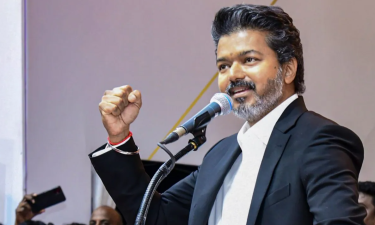
C. Joseph Vijay, the president of the Tamilaga Vettri Kazhagam, was sworn in as the ninth Chief Minister of Tamil Nadu on 10 May 2026 at the Jawaharlal Nehru Indoor Stadium in Chennai. This transition marks the first time since 1967 that a leader from a party other than the Dravida Munnetra Kazhagam or the All India Anna Dravida Munnetra Kazhagam has assumed the office of Chief Minister. The Tamilaga Vettri Kazhagam secured 108 of the 234 seats in the 2026 Legislative Assembly election and established a post-poll coalition with five other political parties to command the legislative majority. Governor Rajendra Vishwanath Arlekar administered the oath of office and secrecy to the Chief Minister and nine Cabinet Ministers.
Electoral Dynamics and Mandate of 2026
Shift in the Bilateral Political Structure
The 2026 election disrupted the nearly six-decade-old bipolar dominance of the Dravida Munnetra Kazhagam (DMK) and the All India Anna Dravida Munnetra Kazhagam (AIADMK). The Tamilaga Vettri Kazhagam (TVK), founded on 2 February 2024, contested 233 constituencies independently and secured roughly 1.7 crore votes out of 4.9 crore votes polled across the state.
Assembly Composition and Majority Matrix
The Tamil Nadu Legislative Assembly consists of 234 elected members, establishing the simple majority threshold at 118 seats.
- TVK Core Strength: The party won 108 seats. The active voting strength adjusted to 107 after the Chief Minister resigned from the Tiruchirappalli East seat while retaining the Perambur constituency.
- Coalition Partners: To safely cross the majority benchmark, TVK secured alliances with the Indian National Congress (5 seats), Viduthalai Chiruthaigal Katchi (2 seats), Communist Party of India (2 seats), Communist Party of India (Marxist) (2 seats), and the Indian Union Muslim League (2 seats).
- Electoral Defeats: The incumbent DMK fell to 59 seats. Former Chief Minister M. K. Stalin lost his legislative seat, and over 30 Cabinet Ministers from the preceding administration were defeated at the polls.
Constitutional and Legislative Proceedings
Execution of the Floor Test
Under the directive issued by Governor Rajendra Vishwanath Arlekar, the newly appointed Chief Minister was required to prove majority support on the floor of the House by 13 May 2026.
- Pro Tem Speaker: Assembly member Karuppaiah from the Sholavandan constituency was appointed to administer oaths to the new legislators and oversee early structural proceedings.
- Confidence Motion Result: The TVK-led government passed the floor test, securing 144 votes in favor. This expanded support materialized due to cross-voting by a rebel faction of 30 AIADMK legislators led by C. V. Shanmugam, who defied their party whip.
Ministerial Profiles and Portfolios
The initial inner cabinet comprises ten ministers, matching the constitutional cap under Article 164(1A) which limits state ministries to 15 percent of total assembly strength.
| Minister Name | Constituency | Portfolios Assigned |
| C. Joseph Vijay (Chief Minister) | Perambur | Home, Public General Administration, Police, IAS, IPS, Municipal Administration, Women and Child Welfare. |
| K. A. Sengottaiyan | Gobichettipalayam | Finance, Pensions, and Pension Allowances. |
| N. Anand | Thiyagarayanagar | Rural Development, Panchayats, Poverty Alleviation, and Irrigation Projects. |
| Aadhav Arjuna | Villivakkam | Public Works (Buildings), Highways, Minor Ports, and Sports Development. |
| K. G. Arunraj | Tiruchengode | Health, Medical Education, and Family Welfare. |
| C. T. R. Nirmal Kumar | Thiruparankundram | Electricity, Non-Conventional Energy Development, Law, Courts, and Prisons. |
| Rajmohan Arumugam | Egmore | School Education, Archaeology, Tamil Official Language, and Information & Publicity. |
Policy Enforcement and Initial Directives
Free Electricity Welfare Scheme
Upon arriving at the state secretariat at Fort St. George, the Chief Minister signed the initial executive files introducing structural welfare changes. The first directive provides 200 units of free electricity per month to every household in Tamil Nadu, expanding the existing subsidised power grid framework.
Institutional Security and Enforcement Units
- Women’s Safety Force: The administration directed the immediate creation of a dedicated special security unit tasked with monitoring, investigation, and preventive policing regarding crimes against women.
- Anti-Narcotics Command: A specialized operations unit was approved to suppress domestic drug smuggling networks and coastal contraband trafficking channels.
- Financial Auditing: The administration announced its intent to issue a comprehensive white paper detailing the state’s financial liability, which was estimated near ten lakh crore rupees at the time of government transition.
IASPOINT Booster Facts for UPSC
Historical Trajectory of Chief Ministers in Tamil Nadu
The democratic history of Tamil Nadu features prominent shifts in leadership eras. The Justice Party and the Indian National Congress held power during the early decades of the Madras State. The year 1967 marked a permanent shift to Dravidian parties when C. N. Annadurai became Chief Minister under the DMK banner. Subsequent decades saw power fluctuate between M. Karunanidhi (DMK) and M. G. Ramachandran or J. Jayalalithaa (AIADMK) until the election of 2026.
Appointment of Non-Legislator as Chief Minister
Article 164(4) of the Indian Constitution states that a minister who is not a member of the State Legislature for any period of six consecutive months shall cease to be a minister at the expiration of that period. While C. Joseph Vijay secured election from his constituency, this constitutional provision permits any citizen to assume the role of Chief Minister or Minister provided they win a seat in the Legislative Assembly or Council within six months of taking the oath.
Rules Governing the Position of Speaker during Trust Votes
The Speaker of the Legislative Assembly normally exercises a casting vote under Article 189(1) of the Constitution only in the event of an exact tie. During a standard motion of confidence or floor test, the Speaker remains in the chair and does not vote in the initial tally, which mathematically alters the active majority calculation required by the treasury benches.
Judicial Restraints on Assembly Voting
The judicial intervention regarding TVK MLA R. Seenivasa Sethupathy, who was restrained by the Madras High Court from participating in the initial trust vote due to an active election petition, highlights the application of Article 329(b). While courts cannot interfere with the electoral process midway, post-election disputes can be challenged via election petitions filed directly in the High Court.
Last Modified: May 19, 2026