
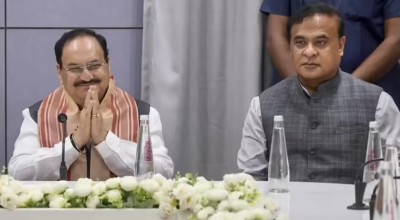
Governor Lakshman Prasad Acharya reappointed Dr. Himanta Biswa Sarma as the Chief Minister of Assam on 10 May 2026 under Article 164(1) of the Constitution of India. The reappointment follows the 2026 Assam Legislative Assembly election, where the Bharatiya Janata Party-led National Democratic Alliance secured a clear majority by winning 102 out of 126 seats. Dr. Sarma was unanimously elected as the leader of both the Bharatiya Janata Party Legislature Party and the National Democratic Alliance Legislature Party. He will take the oath of office for his second consecutive term on 12 May 2026 in Guwahati, with Prime Minister Narendra Modi expected to attend.
Electoral Performance and Mandate
Election Outcome and Seat Share
The 2026 state assembly elections concluded with a decisive mandate for the ruling alliance. The Assam Legislative Assembly has a total strength of 126 seats. A simple majority requires 64 seats, while a two-thirds majority stands at 84 seats. The alliance secured 102 seats, comfortably clearing both benchmarks.
Performance Breakdown by Party
- Bharatiya Janata Party (BJP): Won 82 seats independently, demonstrating a strong performance that places the party 18 seats ahead of the simple majority mark on its own.
- Asom Gana Parishad (AGP): Secured 10 seats.
- Bodoland People’s Front (BPF): Secured 10 seats.
Vote Share Growth
The vote share of the Bharatiya Janata Party has seen a steady upward trajectory over the decade. In 2016, the party registered a vote share of 33.6 percent, which rose to 38.59 percent during the 2026 assembly elections.
Constitutional and Institutional Framework
Appointment Process under Article 164
The appointment of a Chief Minister is governed by Article 164 of the Indian Constitution.
- Article 164(1): States that the Chief Minister shall be appointed by the Governor, and the other Ministers shall be appointed by the Governor on the advice of the Chief Minister.
- Governor’s Discretion: While the Governor formally appoints the Chief Minister, this power is restricted by democratic conventions. The Governor must invite the leader of the party or coalition that commands a clear majority in the Legislative Assembly.
- Collective Responsibility: Article 164(2) mandates that the Council of Ministers shall be collectively responsible to the Legislative Assembly of the State.
Legislative Timeline of Government Formation
- 4 May 2026: Official declaration of the Assam Legislative Assembly election results.
- 6 May 2026: Dr. Himanta Biswa Sarma tendered his resignation to the Governor to clear the path for the dissolution of the previous assembly and the formation of the new government.
- 10 May 2026: Formal reappointment order issued by Governor Lakshman Prasad Acharya following the submission of support letters by the coalition.
- 12 May 2026: Scheduled date for the official swearing-in ceremony in Guwahati.
Structure of the Assam Legislative Assembly
Evolution of the Legislature
The legislature of Assam has undergone several structural transitions since independence:
| Parameter | Historical Status (1952) | Current Status (2026) |
| Type of Legislature | Unicameral (Post-Abolition of Council) | Unicameral |
| Total Assembly Strength | 108 seats | 126 seats |
| Simple Majority Mark | 55 seats | 64 seats |
| Two-Thirds Majority Mark | 72 seats | 84 seats |
Constitutional Provisions on Size of Council of Ministers
Article 164(1A) of the Constitution limits the size of the Council of Ministers in a state. The total number of ministers, including the Chief Minister, cannot exceed 15 percent of the total number of members of the Legislative Assembly. For Assam’s 126-member house, the maximum allowable strength of the ministry is 18 ministers.
IASPOINT Booster Facts for UPSC
Constituent Assembly Debates on Article 164
During the framing of the Constitution, the draft article corresponding to Article 164 was debated extensively. Dr. B.R. Ambedkar clarified that the Governor must use their discretion to find a leader who can command a stable majority, rather than appointing any individual arbitrarily.
Discretionary Powers of the Governor
The Governor possesses situational discretion in appointing a Chief Minister when no single party or pre-poll alliance wins a clear majority. In such a scenario, the Governor can exercise judgment based on the guidelines laid down by the Sarkaria Commission (1983) and the Punchhi Commission (2007), which prioritize pre-poll alliances over post-poll arrangements.
Unicameral vs Bicameral Trend
The Assam Legislative Council was abolished under the Assam Legislative Council (Abolition) Act, 1947, even before the formal adoption of the Constitution. Article 169 of the Constitution empowers the Parliament of India to create or abolish a Legislative Council in a state if the Legislative Assembly of that state passes a resolution by a special majority.
Delimitation in Assam
The 2026 elections were conducted based on the revised boundaries drawn by the Election Commission of India during the delimitation exercise of 2023. While the total number of seats remained constant at 126, boundaries were reshaped, and seats reserved for Scheduled Castes (SC) rose from 8 to 9, and for Scheduled Tribes (ST) from 16 to 19.
Last Modified: May 19, 2026