
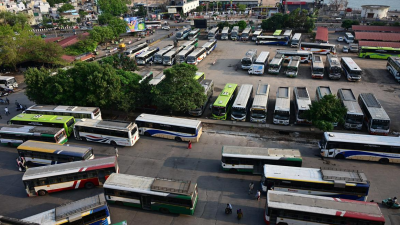
On 13 May 2026, the Supreme Court of India directed all States and Union Territories to mandate the installation of Vehicle Location Tracking Devices (VLTDs) and emergency panic buttons in public service vehicles, including buses, taxis, and app-based cabs. The order deliberately excludes two-wheelers, three-wheelers, e-rickshaws, and categories that do not require commercial permits under the Motor Vehicles Act, 1988. Issued by a bench comprising Justices J.B. Pardiwala and K.V. Viswanathan during the hearing of a long-standing public interest litigation, the directive addresses a major safety gap, as current data reveals that less than one percent of active public transport vehicles possess these devices.
Judicial Context and Directives
The Supreme Court intervention targets immediate verification and compliance mechanisms across the transport sector.
Origin of the Litigation
The directive arose from the public interest litigation S. Rajaseekaran v. Union of India, initiated by a Coimbatore-based orthopedic surgeon to address India’s high rate of road accident fatalities and the slow execution of safety regulations by regional authorities.
Interlinking Fitness and Permits
The Court ruled that state transport authorities must stop issuing or renewing fitness certificates under Section 56 or commercial permits under Section 66 of the Motor Vehicles Act, 1988, for any public service vehicle that fails to show a verified, functional installation of a VLTD and emergency button.
Deployment Timeline
States must enforce a dual-track implementation timeline:
- New Vehicles: Must be equipped with compliant tracking hardware at the point of manufacture.
- Existing Vehicles: Public transport vehicles registered up to 31 December 2018 must be systematically retrofitted with the safety units within a time-bound schedule.
Statutory and Technological Architecture
The safety mandate operates through a combination of federal transport laws, technical standards, and digital databases.
Legal Provisions
- Rule 125H of the Central Motor Vehicles Rules, 1989: Mandates the fitment of tracking devices and distress buttons in public transport vehicles to facilitate real-time monitoring.
- The Justice J.S. Verma Committee Recommendations: The structural framework for tracking public transport stems from the legal recommendations made by the Justice Verma Committee following the 2012 Nirbhaya case, highlighting passenger security for women and children.
- Rule 118 of the Central Motor Vehicles Rules, 1989: Works alongside Rule 125H to govern the mandatory installation of Speed Limiting Devices (SLDs) or speed governors in commercial vehicles.
System Specifications (AIS-140)
The hardware must comply with the Automotive Industry Standard 140 (AIS-140). This standard defines the protocol for vehicle tracking, camera surveillance integration, and emergency button operations. When a passenger presses the panic button, the system transmits an immediate distress alert with precise coordinates to state-run monitoring centers and local police control rooms.
Digital Tracking Integration
Every verified hardware installation must register live on the centralized VAHAN portal. The Ministry of Road Transport and Highways (MoRTH) uses this integration to allow enforcement officers to check compliance status digitally during routine field checks or automated toll assessments.
Implementation Status Across Indian Jurisdictions
The current enforcement landscape exhibits variations in infrastructure readiness and compliance levels.
| Operational Component | Current Compliance Status | Statutory Target Goal |
| VLTD Installation Rate | Polarized at less than 1% of transport vehicles nationwide | 100% saturation for all eligible public service vehicles |
| Speed Governor Fitment | Stagnant at less than 5% nationwide compliance | Comprehensive tracking linked with factory production |
| Command Control Centers | Operational across 27 States and Union Territories | Unified national-level backend monitoring network |
| National Road Safety Board | Delayed constitution | Final 3-month Supreme Court deadline for operationalization |
IASPOINT Booster Facts for UPSC
- Definition of Public Service Vehicle: Under Section 2(35) of the Motor Vehicles Act, 1988, a public service vehicle means any motor vehicle used or adapted to be used for the carriage of passengers for hire or reward, including maxicabs, motorcabs, stage carriages, and contract carriages.
- Sovereign Database Linkage: The VAHAN portal is a centralized national registry created by MoRTH to digitize vehicle registration certificates, fitness logs, and permit data across more than 1,200 Regional Transport Offices (RTOs).
- The Nirbhaya Framework Budget: The initial operational scheme for state-wise vehicle tracking platforms was approved on 15 January 2020, drawing financial allocations from the central Nirbhaya Fund to set up regional monitoring hubs.
- National Road Safety Board (NRSB): Envisioned under Section 215B of the Motor Vehicles Act, the NRSB is a statutory advisory body mandated to formulate specialized rules on road safety, design standards, and traffic management strategies.
- Seventh Schedule Status: “Mechanically propelled vehicles,” including the regulation of motor vehicles, falls under Entry 35 of the Concurrent List (List III) of the Seventh Schedule, giving both the Centre and individual states shared legislative jurisdiction.
SANJEEV SINGHAL
May 15, 2026 at 1:21 pmGOOD