
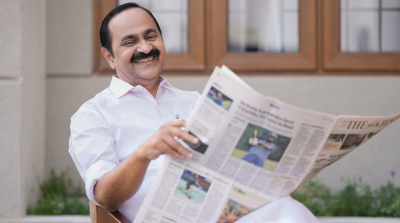
On 14 May 2026, V.D. Satheesan was officially appointed as the Chief Minister-designate of Kerala, following a decisive electoral victory by the Congress-led United Democratic Front (UDF) in the 2026 state legislative assembly elections. The official declaration of results on 4 May 2026 confirmed that the UDF secured 102 out of the 140 elected seats in the legislature, effectively terminating the decade-long administration of the Left Democratic Front (LDF) headed by Pinarayi Vijayan of the Communist Party of India (Marxist). Following internal leadership evaluations by the All India Congress Committee, Satheesan assumes office as the 13th Chief Minister of Kerala, bringing an end to the previous Left-led executive governance.
Political Profile of V.D. Satheesan
The newly appointed executive head possesses an extensive legislative background within the state assembly frameworks.
Legislative Background and Electoral History
- Constituency Representation: V.D. Satheesan, aged 61, has continuously represented the Paravur Assembly constituency in the Ernakulam district since his initial election victory in 2001.
- Leader of the Opposition: He served as the Leader of the Opposition in the Kerala Legislative Assembly from 2021 to 2026, acting as a prominent critic of the previous LDF administration.
- Organisational Role: He holds the office of Vice President within the Kerala Pradesh Congress Committee (KPCC) and is recognized for managing the alliance’s campaigns during the 2024 general elections and subsequent local body polls.
Coalition Dynamics and Support Base
- The United Democratic Front Structure: The UDF operates as a multi-party political alliance, with the Indian National Congress (INC) serving as the single largest unit, winning 63 seats in the 2026 cycle.
- Key Alliance Partners: The Indian Union Muslim League (IUML), which secured 22 legislative seats, provided formal endorsement for Satheesan’s leadership, establishing a unified block during the post-election government formation process.
Constitutional Provisions Governing the State Executive
The appointment, structure, and accountability of the state leadership follow specific constitutional mechanisms detailed in Part VI of the Constitution of India.
Article 164: Appointment and Status of Ministers
- Process of Appointment: The Chief Minister is appointed directly by the Governor under Article 164(1). The remaining ministers are appointed by the Governor based entirely on the formal advice tendered by the Chief Minister.
- Pleasure of the Governor: Ministers hold office during the pleasure of the Governor, though this is constitutionally bound by the majority support the cabinet commands in the lower house.
- Collective Responsibility: Under Article 164(2), the Council of Ministers is collectively responsible to the Legislative Assembly of the State. A loss of confidence in the assembly necessitates the resignation of the entire ministry.
- Oath and Secrecy: Before a minister assumes charge, the Governor administers the oaths of office and of secrecy according to the forms set out in the Third Schedule.
- Six-Month Procurement Rule: A minister who is not a member of the state legislature for any period of six consecutive months automatically ceases to be a minister at the expiration of that period.
Administrative Limits and Auxiliary Provisions
- Article 163: Establishes a Council of Ministers with the Chief Minister at the head to aid and advise the Governor in the exercise of his functions, except where the Governor is required to act in his discretion.
- Article 167: Defines the explicit duties of the Chief Minister respecting the furnishing of information to the Governor regarding all decisions of the Council of Ministers relating to the administration of the affairs of the state.
- The 91st Constitutional Amendment Act, 2003: This amendment introduced Article 164(1A), stipulating that the total number of ministers, including the Chief Minister, in the Council of Ministers in a State shall not exceed 15% of the total number of members of the Legislative Assembly of that State, provided that the number of ministers shall not be less than 12.
Comparative Breakdown of the 2026 Kerala Assembly Mandate
The legislative matrix of the 140-member house underwent a realignment following the 2026 democratic exercise:
| Political Coalition | Dominant Constituent Parties | Seats Won (2026) | Previous Status (2021-2026) |
| United Democratic Front (UDF) | Indian National Congress (INC), Indian Union Muslim League (IUML) | 102 | Opposition Block |
| Left Democratic Front (LDF) | Communist Party of India (Marxist) [CPI(M)], Communist Party of India (CPI) | 35 | Ruling Government |
| National Democratic Alliance (NDA) | Bharatiya Janata Party (BJP) | 03 | Minimal Representation |
IASPOINT Booster Facts for UPSC
- The First Chief Minister of Kerala: Elamkulam Manakkal Sankaran Namboodiripad (E.M.S. Namboodiripad) became the first Chief Minister of the newly formed Kerala state in 1957, heading the first democratically elected Communist government in the world outside of San Marino.
- Unicameral versus Bicameral Structure: The Kerala State Legislature is strictly unicameral, consisting only of the Governor and the Legislative Assembly (Vidhan Sabha). It does not feature a Legislative Council (Vidhan Parishad).
- Article 356 and State Dismissal: The first EMS Namboodiripad ministry was dismissed by the Central Government in 1959 using Article 356 (President’s Rule) following the Vimochana Samaram (Liberation Struggle), establishing an early precedent for federal intervention.
- Constitutional Status of the Leader of the Opposition: The position of the Leader of the Opposition is a statutory post defined under specific state legislative acts, granting the holder the rank and executive facilities equivalent to a Cabinet Minister.
- Sovereignty of Assembly Quorum: Under Article 189(3), the minimum quorum required to constitute a formal sitting of the State Legislative Assembly is ten members or one-tenth of the total number of members of the House, whichever is greater.