
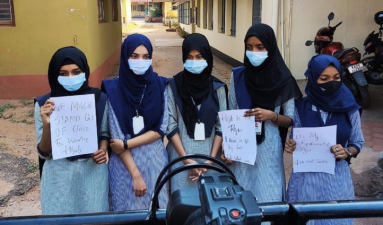
The Karnataka government formally withdrew its February 2022 order that banned the hijab and other religious vestments in state-aided, government, and private schools and pre-university colleges on 13 May 2026. A fresh circular issued by the Department of School Education and Literacy replaced the older directive, introducing a modified framework that allows students to wear limited traditional and faith-based markers alongside their prescribed institutional uniforms. The revised policy aims to resolve public controversies and administrative friction arising from dress code enforcements while establishing a standardized baseline for classroom inclusion across the state’s primary and secondary educational systems.
The Revised Policy Framework
The 2026 circular maintains the mandatory status of school uniforms but permits specific religious articles under strict regulatory conditions.
Approved Religious and Customary Symbols
- Headscarf / Hijab: Permitted for Muslim female students, provided it aligns contextually with the school uniform colors where applicable.
- Peta / Turban: Permitted as traditional headgear, primarily for Sikh students and specific regional communities.
- Janivara / Sacred Thread: Re-allowed for students following specific Hindu customs, addressing recent exam-centre controversies.
- Other Faith Artifacts: Shivadhara, Rudraksha beads, and Sharavastra are explicitly codified as permissible personal markers.
Operational Restrictions and Safety Guidelines
- Identification Rules: Faith-based articles must not conceal a student’s face or hinder immediate visual identification by institutional authorities.
- Complementary Character: Permitted items must remain supplementary to the uniform and cannot alter, replace, or defeat the basic layout of the prescribed institutional attire.
- Non-Coercion Clause: No student can be forced by institutional heads to remove a permitted symbol. Conversely, no student can be compelled by peers or external groups to wear one.
- Examination Carve-Out: National and state-level examination bodies retain independent authority to enforce separate, specialized dress codes during competitive assessments to prevent malpractice.
Constitutional and Legal Foundations
The balancing act between institutional discipline and freedom of religion involves core constitutional provisions and conflicting legal interpretations.
Key Constitutional Articles
- Article 25(1): Guarantees freedom of conscience and the right freely to profess, practice, and propagate religion, subject to public order, morality, and health.
- Article 14 and 15(1): Directs state mechanisms to maintain equality before the law and prohibits discrimination against any citizen on grounds only of religion, race, caste, sex, or place of birth.
- Article 19(1)(a): Protects the right to freedom of speech and expression, which legal advocates argue includes personal choices regarding clothing and attire.
- Article 21 and 21A: Guarantees the protection of life and personal liberty, alongside the fundamental right to free and compulsory education for children aged 6 to 14 years.
Judicial History of the Karnataka Hijab Dispute
| Judicial Forum | Judgment Date | Core Legal Ruling / Outcome |
| Government of Karnataka | 5 February 2022 | Issued Order No. ED 141 LGE 2022 banning clothing that disturbs public order, effectively prohibiting hijabs in uniform-enforcing schools. |
| Karnataka High Court | 15 March 2022 | Upheld the government ban; ruled that wearing a hijab does not constitute an Essential Religious Practice (ERP) in Islam. |
| Supreme Court of India | 13 October 2022 | Delivered a split verdict (Justice Hemant Gupta upheld the ban; Justice Sudhanshu Dhulia set it aside), referring the matter to a larger bench. |
| Department of School Education | 13 May 2026 | Formally rescinded the 2022 order with immediate effect, rendering contrary institutional guidelines null and void. |
Administrative Guidelines for Educational Heads
The circular mandates School Development and Monitoring Committees (SDMCs) and College Development Committees (CDCs) to implement the directive without communal bias.
- Admission Protections: Educational institutions are legally barred from denying campus entry, admission, or academic progress to students sporting permitted faith symbols.
- Elimination of Humiliation: Institutional authorities face penalties if found guilty of subjecting students to insulting or demeaning treatment because of their traditional attire.
- The Basaveshwara Principle: The text explicitly commands schools to embrace the social philosophy of 12th-century reformer Basavanna, quoting the phrase Iva Nammave (“They are ours”) to promote social harmony.
IASPOINT Booster Facts for UPSC
- The Essential Religious Practice (ERP) Test: A judicial doctrine evolved by the Supreme Court of India in the Shirur Mutt case (1954) to determine which religious practices are central to a faith and immune from state intervention under Article 25.
- The Bijoe Emmanuel Case (1986): A landmark Supreme Court precedent where the court protected Jehovah’s Witness students who refused to sing the National Anthem due to religious beliefs, ruling that silent respect does not violate public order.
- State Legislation Links: The initial 2022 restrictions drew power from Section 133(2) of the Karnataka Education Act, 1983, which empowers the state government to issue structural directives to educational institutions.
- Saffron Shawl Controversies: The 2026 guidelines do not classify political or reactionary garments, such as saffron shawls, under the category of long-standing religious symbols, keeping them restricted in classrooms.
- Ambedkar’s View on Schools: Dr. B.R. Ambedkar envisioned educational centers as secular, democratic spaces designed to foster a scientific temper and critical thinking, separate from deep-seated caste and communal divisions.