
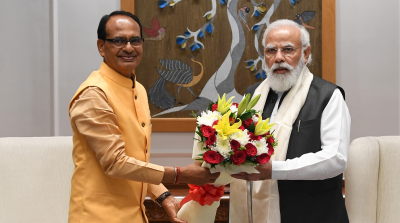
Former Vice President M. Venkaiah Naidu and former Prime Minister H. D. Deve Gowda officially released a memoir titled Apnapan: Narendra Modi sang mere anubhav at the National Agricultural Science Centre (NASC) Complex in New Delhi on May 26, 2026. The 11-chapter book is authored by Union Minister for Agriculture, Farmers Welfare, and Rural Development Shivraj Singh Chouhan. It documents over three decades of political, administrative, and personal interactions between Chouhan and Prime Minister Narendra Modi. Rather than a standard autobiography, the book serves as a structural study of cooperative governance, highlighting how the two leaders managed state-level administrations as Chief Ministers of Madhya Pradesh and Gujarat before working together at the federal level.
Core Themes and Historical Narrative
The text records key milestones in India’s modern political history, analyzing leadership and policy execution from an insider’s perspective.
Early Political Association
The book outlines the 35-year relationship between the author and Narendra Modi, tracing their trajectory from grassroots organizational workers in the Bharatiya Janata Party (BJP) to high-ranking governance roles. A critical section focuses on the 1991 Ekta Yatra led by Murli Manohar Joshi, where Modi managed the nationwide logistics. Chouhan details the operational challenges faced during peak militancy in Jammu and Kashmir, culminating in the unfurling of the national flag at Srinagar’s Lal Chowk on January 26, 1992.
Digital Vision and Technology Integration
The memoir features early instances of Modi’s emphasis on technological adoption. Chouhan recounts party meetings from the late 1990s where Modi advocated for digital connectivity and email communication among public representatives long before digital infrastructure became central to Indian public administration and electronic delivery of services.
Inter-State Cooperative Federalism
A major analytical focus of the book covers the period when Modi served as the Chief Minister of Gujarat (2001–2014) and Chouhan served as the Chief Minister of Madhya Pradesh (2005–2023). The text details how both state administrations collaborated on cross-border water management, agricultural optimization, and regional resource sharing, offering a template for active cooperative federalism.
Administrative Insights and Policy Frameworks
The narrative transitions into structural governance practices, illustrating the execution of welfare schemes and infrastructure projects.
Water Resource Management
The book documents specific policy discussions on irrigation and water security. It highlights collaborative efforts in filling existing reservoirs and constructing new water-harvesting structures, which directly helped Madhya Pradesh transform its agricultural growth rate during Chouhan’s tenure.
Rural and Agricultural Welfare
Drawing from his experience as a four-term Chief Minister and current Union Agriculture Minister, Chouhan connects his past state-level interventions with central policy objectives. The book analyzes the design and scaling up of direct benefit transfers and crop insurance models aimed at mitigating agrarian distress.
| Aspect | Key Contextual Event / Policy | Administrative Value |
| Organizational Origin | 1991 Ekta Yatra (Kanyakumari to Srinagar) | Structural crisis management and security execution under pressure. |
| Technology Adoption | Early implementation of ICT in party work (Late 1990s) | Foresight in utilizing digital tools for governance and public outreach. |
| Cooperative Federalism | Simultaneous tenures as CMs of MP and Gujarat | Collaborative resolution of inter-state resource distribution and water management. |
| Welfare Philosophy | Inclusive development models (Sabka Saath, Sabka Vikas) | Transitioning grassroots welfare interventions into scalable national policies. |
IASPOINT Booster Facts for UPSC
- The Concept of Cooperative Federalism: Unlike competitive federalism where states compete for resources, cooperative federalism involves the Centre and States working horizontally to solve common governance challenges. Article 263 of the Constitution provides for an Inter-State Council to facilitate this coordination.
- The 1991 Ekta Yatra: This political march was organized to support national integration and challenge secessionist movements in Jammu and Kashmir. It commenced from Kanyakumari in December 1991 and concluded with the hoisting of the tricolor at Lal Chowk under tight security protocols.
- Chief Ministerial Longevity: Shivraj Singh Chouhan holds the record for being the longest-serving Chief Minister of Madhya Pradesh, holding office for over 17 years across four separate terms between 2005 and 2023.
- Constitutional Bodies for Inter-State Disputes: Under Article 262 of the Constitution, Parliament has the sole authority to adjudicate disputes relating to waters of inter-state rivers or river valleys, leading to the creation of various Inter-State River Water Disputes Tribunals.
- Evolution of e-Governance in India: Systematic digital governance in India began with the establishment of the National Informatics Centre (NIC) in 1976, followed by the launch of the National e-Governance Plan (NeGP) in 2006 to make all government services accessible to the common man.