
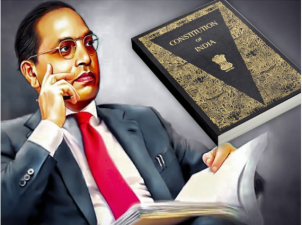
The birth anniversary of Dr B R Ambedkar marks his central role in shaping the Constitution of India, the legal foundation of the world’s largest democracy. Adopted in November 1949 and enforced on 26 January 1950, the Constitution established the principles of justice, liberty, equality and fraternity. Ambedkar, as Chairman of the Drafting Committee, ensured that the document addressed historical injustice and created safeguards for marginalised communities.
Ambedkar’s Constitutional Vision
Ambedkar believed that political democracy could survive only with social and economic democracy. His experience of caste discrimination influenced his insistence on equality before law, abolition of untouchability, and protection of Scheduled Castes, Scheduled Tribes and other disadvantaged groups. He viewed rights not as abstract ideals but as instruments for social transformation.
Response to Social Inequality
The Constitution was designed as a response to centuries of exclusion. It recognised the need for affirmative action, access to education, and protection from discrimination. Ambedkar’s earlier struggles, including the Mahad Satyagraha and temple entry movements, shaped this approach. The constitutional framework aimed to replace inherited privilege with citizenship based on dignity and equal opportunity.
Democracy, Rights and Institutions
Ambedkar argued that democracy must extend beyond elections. He linked freedom with social justice, labour rights, women’s rights and economic fairness. The Constitution also created strong institutions such as an independent judiciary, a federal system, and mechanisms of checks and balances. These features support accountability, stability and constitutional governance. His economic thinking also influenced policy institutions such as the Finance Commission.
Enduring Relevance of the Constitution
The Constitution has evolved through amendments and judicial interpretation, yet its core values remain intact. In 2015, 26 November was declared Constitution Day to promote constitutional values. Ambedkar’s legacy continues to guide debates on equality, inclusion, federalism and rights in modern India.
Last Modified: April 27, 2026