
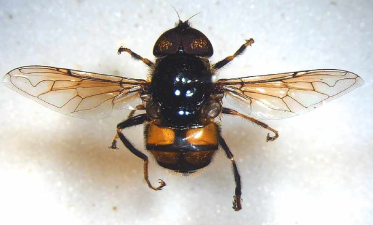
Scientists from the Zoological Survey of India (ZSI) recently discovered two new hoverfly species, Eristalinus sapphirinus and Eristalinus brunettii, in the Gangetic Plains of West Bengal. This discovery marks the first addition to India’s Eristalinus fauna in over a century. Researchers confirmed the new species using an integrative approach that combined traditional physical morphology with mitochondrial DNA barcoding. The findings highlight that human-modified landscapes, like the heavily populated Gangetic Plains, still harbor undocumented insect biodiversity. These hoverflies play a critical dual ecological role as adult pollinators and aquatic waste recyclers.
Overview of the New Species
The genus Eristalinus belongs to the family Syrphidae, commonly known as hoverflies or flower flies. The two newly identified species expand the known distribution of these insects in the Indian subcontinent.
Eristalinus sapphirinus
This species is distinguished by its unique physical coloration. It features a brilliant, sapphire-blue metallic sheen on its abdomen. Researchers collected the type specimens from rural and semi-urban agricultural pockets within the West Bengal region.
Eristalinus brunettii
Named in honor of the historic dipterist James Edward Brunetti, who contributed extensively to Indian entomology, this species displays distinct dark brown and dull metallic thorax markings. Its physical features separate it from previously documented look-alikes in the region.
Key Characteristics and Methodology
The discovery relied on a multi-disciplinary taxonomic framework to prevent errors in classification.
| Parametric Feature | Details and Implementation |
| Taxonomic Family | Syrphidae (Order: Diptera) |
| Discovery Site | Gangetic Plains ecosystem, West Bengal, India |
| Morphological Analysis | Detailed examination of male genitalia structures, wing venation patterns, and body coloration |
| Molecular Identification | Mitochondrial DNA barcoding targeting the Cytochrome c Oxidase Subunit I (COI) gene |
| Validation Methods | Computational species-delimitation algorithms to verify genetic divergence from known species |
Ecological Roles and Environmental Value
Hoverflies are unique insects because their ecological functions shift completely from the larval stage to adulthood.
Adult Stage as Pollinators
Adult hoverflies feed exclusively on nectar and pollen. They serve as key vectors for pollen transfer in agricultural fields, orchards, and wild ecosystems. Their flight mechanism allows them to hover in place before landing on flowers, making them highly efficient pollinators for crops such as mustard, coriander, and various fruits.
Larval Stage as Decomposers
The larvae of the genus Eristalinus are aquatic or semi-aquatic. Commonly referred to as “rat-tailed maggots” due to a long, telescopic breathing tube, they live in nutrient-rich, stagnant water bodies. They consume decomposing organic matter, fecal waste, and microbes. This feeding process purifies water bodies and speeds up nutrient recycling in wetland ecosystems.
Biogeographic Context of the Gangetic Plains
The Gangetic Plains are characterized by intensive agriculture, high human population density, and fragmented natural habitats. Finding new insect species in this landscape demonstrates that biodiversity can persist in human-dominated areas. It emphasizes the need to survey unprotected, modified ecosystems rather than focusing field research solely on pristine national parks and wildlife sanctuaries.
IASPOINT Booster Facts for UPSC
- Zoological Survey of India (ZSI): Established in 1916, ZSI is a premier premier research organization under the Ministry of Environment, Forest and Climate Change (MoEFCC). It is headquartered in Kolkata.
- Syrphidae Family Mimicry: Many hoverflies exhibit Batesian mimicry. They mimic the bright yellow and black warning coloration of stinging bees and wasps to deter predators, even though hoverflies are completely harmless and lack stingers.
- DNA Barcoding: This technique uses a short genetic sequence from a standard localized part of the genome to identify an organism to the species level, acting like a supermarket scanner code.
- Bioindicators: Eristalinus larvae act as bioindicators of organic pollution. Their presence in large numbers typically points to high levels of organic waste and low dissolved oxygen in water bodies.